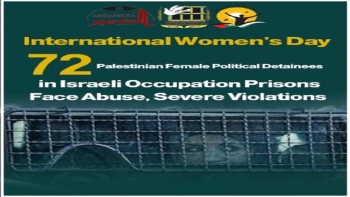

• International Women’s Day: 72 Palestinian Female Political Detainees in Israeli Occupation Prisons Face Abuse, Severe Violations

    International Women’s Day: 72 Palestinian Female Political Detainees in Israeli Occupation Prisons Face Abuse, Severe Violations

  • Commission of Detainees uncovers details of abuses against detainee Mohammad Wajeeh Mahamid from Jenin

    Commission of Detainees uncovers details of abuses against detainee Mohammad Wajeeh Mahamid from Jenin

  • Medical neglect endangers the lives of detainees held in the clinic of Ramla prison

    Medical neglect endangers the lives of detainees held in the clinic of Ramla prison

  •  New Measures Against Administrative Detainees Entrench Ongoing Violations and Undermine International Law

    New Measures Against Administrative Detainees Entrench Ongoing Violations and Undermine International Law

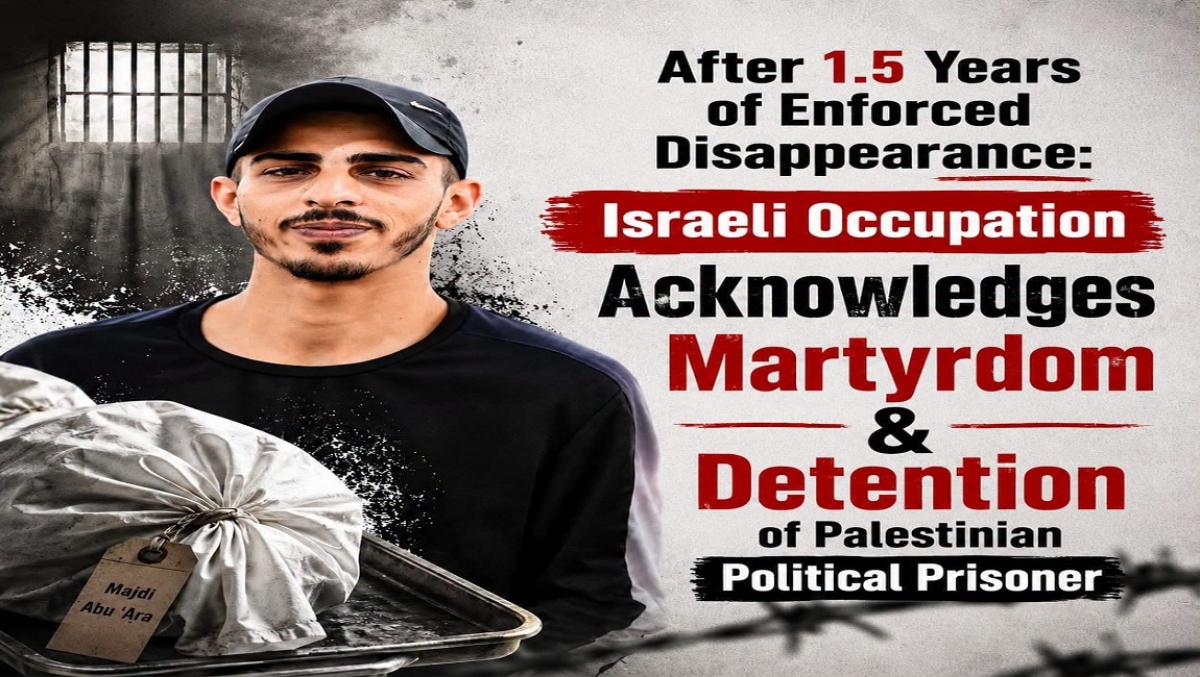
  •  Palestinian Medic Abducted From Gaza During Kamal Adwan Hospital Siege, Killed in Israeli Occupation Prison

    Palestinian Medic Abducted From Gaza During Kamal Adwan Hospital Siege, Killed in Israeli Occupation Prison

  • 1
  • 2
  • 3
  • 4
  • 5

A detainee narrates the moments of torture by 15 soldiers during his arrest

on . Posted in slider

The Commission of Detainees and Ex-Detainees Affairs cites the testimony of the detainee Ammar Mohammad Shakarneh (21 years old) from Nahhaleen village near Bethlehem, who was tortued and beaten by Israeli soldiers during his arrest in 24/1/2019.
Shakarneh told the advocate of the commission that 15 armed soldiers broke into his house at midnight and destroyed all its belongings, and attacked him in a barbaric way all over his body.
He added: "they handcuffed me and blindfolded me, and then they drove me to Betar settlement". He remained in the settlement for 3 hours in the cold weather before being transferred to Itzion detention center.
In addition, the detective hit the detainee, cursed him and threatened him to force him confess guilt.
 

Repression forces break into section "17" at Ofer prison and a state of tension prevails

on . Posted in slider

A report issued by the Commission of Detainees and Ex-Detainees' Affairs stated that the Israeli repression forces "Drour" accompanied with forces from the Israeli police broke into section 17 at Ofer prison, and conducted inspections and missed with the belongings of detainees.
The Commission pointed out that the repression forces have closed ten section in the prison after the breaking in and inspection process, and that a state of tension and disorder prevailed in the prison since the first hours of dawn.
The Commission also stated that the detainees in all sections have returned their meals in a protest against the break in.

Facts about Palestinian female detainees at "Damoun" prison

on . Posted in slider

The Commission of Detainees and Ex-Detainees' Affairs stated in its report some of the daily situations lived by female detainees at Damoun prison, which show the extent of violations they are exposed to on a daily basis, violate all international treaties, conventions and human rights principles.
The nature of Damoun prison:
Damoun prison is located north of Palestine on the Mount of Carmel in Haifa city. It was established since the British Mandate as a store of cigarettes. The land was owned by the Qurman's family from Haifa, and after 1948 it was seized by Israel and turned into a prison. The infrastructure of it was very bad and there was an order to close it because it lacks the minimum standards of living. However, with the outbreak of Al-Aqsa Intiafda and the increase of Palestinian detainees, it was reopened. It currently holds 500 detainees, most of who are detained on the grounds of illegal entry to the occupied territories, and it contains a section where 53 female detainees are held.
Conditions of female detainees after being transferred to Damoun prison
On November 2018, all political female detainees were gathered at Damoun prison.
-    Before transferring female detainees from Al-Sharon prison to Damoun prison, females of Damoun prison got transferred from their sections. They were held at section 6 and then transferred to section 3. They got transferred with 6 phases dating from 31/10/2018 to 7/11/2018.
-    The administration of Damoun prison tried to distribute the female detainees on section, but the females refused and asked to choose their sections. As means of protest, they gathered and sit in the yard of the prison and refused to get inside their cells. After negotiations with the prison's administration they were allowed to supervise their own distribution and arrangement of sections.
-    There are 53 female detainees at Damoun prison including: one minor female, a deputy in the legislative council, 8 injured females, 22 mothers and wives, 19 female arrested under interrogation, 2 females under the administrative detention and 3 females from Gaza Strip who are prevented from family visits.
-     It is worth mentioning that the sentences issued against the female prisoners reached a maximum of 16 years.
-    Females are held in sections that contain 13 rooms, and there are 4-8 females in each room. There is a solitary confinement with surveillance cameras, and also there is a room used to educate minors which is opened only once a week.
-    Counting is done 4 times a day, and inspection is done twice a day.
-    There is no safety for female detainees inside rooms, where beds are so high which resulted in many cases of falling down.
-    Regarding water in the section: females buy mineral water from the canteen on their expense.
-    Each family is allowed to enter two books in a month after getting a permit.

The yard of the prison
-    There are two surveillance cameras in the yard, where female detainees are monitored by jailers. This prevents females from doing exercises and seeing the seeing the sun rays, especially that most of them put on hijabs.
-    Female detainees are not allowed to gather in the yard.
-    They spend 4 hours in the yard, in which time is distributed to bath tine, director visit and lawyers visits.
-    The yard has no ceiling, so the females do not go outside during the rain.

Restrooms
-    It is worth to mention that restrooms are located outside the prison's cells, which prevents females to use it in any time. Females are also not allowed to bathe unless at the time of the going to the yard. Females are forced to walk from their rooms through the yard which make them feel embarrassed.

Education
-    Female detainees are prevented from obtaining educational material, and lately the prison's administration found some materials and confiscated them.
-    There is no library for female detainees, and they did not receive the books brought by female detainees who were jailed at Al-Sharon prison.
-    The classroom that was opened for minors' education is very small and does not have a window, and it is only opened once a week.

Medical treatment
-    There is a bureaucracy to ask for the entry of specialized doctors from abroad, since it takes a long time to get permission to enter the prison. There is procrastination in transferring sick detainees to hospitals and making operations. A case in point is the case of the detainee Israa Ja'abees, who needs a special suit for the burns in her body and a plastic surgery due to the deformation in her face.
Products and stuff distributed by the prison's administration
-    There is no specific list of products that are distributed at sections every month. The list lacks the special needs of females. According to instructions, female detainees must be provided with their own special stuff.
Materials for handcrafts
-    Families of detainees are prevented from giving their daughters material for making handcrafts, and only materials from the Committee of the Red Cross are allowed.
Females under arrest
-    Any girl under arrest, who is not held in interrogation centers, is transferred between borders of Mascoubya, Ramlah and Al-Sharon in harsh conditions. She is transferred to Damoun prison after one month of arrest. In many cases, girls are held in solitary confinement. A case in point is the detainee Iftikar Zakarneh, who was transferred to Ramlah prison after one month of interrogation.


Conditions of transferring female detainees to courts
-    When female detainees are transferred to courts they got tightly handcuffed and treated in bad way.
-    Detainees who are prosecuted in military Salem court and Lod court face many troubles due to holding them at Jalamah, Sharon and Ramlah borders in harsh conditions, and the way to court takes 3 hours which is considered a journey of suffering.
-    A new achievement is accomplished regarding the transfer process of female detainees. This is due to complaints on transferring detainees who are prosecuted at Jerusalem court and Beersheba court, where previously they were transferred before one day of court date and the detainee remain 3 days in harsh isolation conditions. The new achievement is that the transferring process for female detainees takes only one day.
Family visits
-    There are visit request every week, where the representative of the detainees get very busy in applying requests for 53 detainees to enter clothes, books and photographs.
-    Regarding the female detainees from Gaza Strip, they are prohibited from family visits due to the siege. After making many requests by the Commission of Detainees Affairs, they got allowed to phone call their families for 45 minutes.

Lawyers' visits
-     There is only one room for the lawyers' visits and it is very small, and the lawyer is allowed to visit only 3 detainees.
Administrative detention
The Israeli occupation inherited the administrative detention form the British mandate, where it was the emergency law of the British mandate in 1945 and then was adopted by Israel.
Israel announced the state of emergency in 1948, where the administrative detention is used to arrest Palestinian politicians.
 The concept:
It is an arbitrary detention used by the Israeli authorities to arrest persons without any charge. According to the Israeli intelligence, it is a preventive measure to prevent any person from making any breach in the future, and there is no specific period for detention.
The administrative detention is conducted without a prosecution and it is based on an order issued by the military commander of area depending on confidential files.
-    Palestinians are detained under administrative detention for long periods under the pretext of "confidential information", which are not known by the detainees or lawyers.
-    Although the maximum period of administrative detention is 6 months, it could be prolonged and renewed until further notice. This unjust detention deprives the prisoners of the right to know the information they have been detained for and keeps them in darkness for long periods, since they do not know when they will be released, and sometimes it takes years.
-    Female detainees under administrative detention:
1.    The detainee Khalida Jarrar: member in the legislative council, she's 55 years old from the city of Ramallah. She was arrested in July 2, 2017. The military commander issued the order of administrative detention against her and it was renewed and extended.
The first extension of the order was in 27/12/2018 to 6 months.
The second extension in 26/6/2018 to 4 months
The third extension in 25/10/2018 to 4 months
The order of administrative detention ends by 28/2/2019.
2.    The detainee Fidaa Du'mos (24 years old), is form Bait Ummar near Hebron. She was arrested On May 29, 2018 and was sentenced to 95 days of actual imprisonment. At the day of release, an order of administrative detention to 6 months was issued, it ends by 15/2/2019.

The Israeli authorities abuse and beat 5 detainees from the same family

on . Posted in slider

The commission of Detainees and Ex-Detainees Affairs cited on Wednesday, through the advocate Jaclyn Fararjeh, the testimonies of five detainees from the Shakarneh's family from Bethlehem who got abused by the occupation forces during their detention and interrogation at Etzion Detention Center.
The advocate stated that the detainees Omar Muhammad Shakarneh, Ibrahim Sha'ban Shakarneh, Abdullah Ahmad Shakarneh, Ammar Mohammad Shakarneh and Hussam Kamal Shakarneh were brutally beaten and assaulted during their arrest from Nahhaleen village.
The advocate pointed out that they were handcuffed after being arrested, and the soldiers threw them on the ground and started to jump over them as a means of beating. Then they put the five detainees in the military vehicle and continue to beat them until they reach the settlement of "Betar". They remained there for three hours while being handcuffed and blindfolded.
It is noteworthy to say that Etzion Detention Center is one of the worst detention centers of the Israeli occupation army, where detainees are held inside bad rooms filled with insects and rats and got subjected to all types of physical and psychological torture and abuse.


A protest in solidarity of the Palestinian detainees in Berlin the German capital

on . Posted in slider

The Arab and Palestinian communities in Berlin have organized a solidarity stand with the Palestinian detainees in Israeli jails at the Potsdamer Platz square in Berlin, with the participation of many institutions.
These ongoing events in Germany come at the time of systematic repression against the Palestinian prisoner movement, and against the practices of prisons' administrations.
The international coordinator of "Samedoun network" Charlotte Keats stressed on the need to promote the international boycott of (BDS) against the state of occupation. This came in support of the struggle of the Palestinian detainees and the rights of Palestinian people, and against the companies and states that support the racist entity of Israel.
Keats called for the solidarity with the Palestinian detainees in facing the attack launched by the Israeli Minister of Defense, Gilad Erdan.
Many European countries and other countries all over the world witness a series of solidarity events in the National Day of solidarity with the detainee Ahmad Sa'adat, which started on January 15 and lasts to January 22.
 

The Commission of Detainees and Ex-Detainees' Affairs sends an urgent letter to many international bodies about the critical health conditions of Abu Dyak

on . Posted in slider

The Commission of Detainees and Ex-Detainees' Affairs sent on Monday an urgent letter to many international bodies and humanitarian and legal institutions warning about the critical health condition of the sick detainee Sami Abu Dyak, requesting an immediate intervention to save his life before it's too late.


 The Commission explained in the letter, which was sent to more than 20 international bodies including the International Quartet, the Office of the European Union, the Office of the High Commissioner for Human Rights and the World Health Organization, that there is a real anxiety that threatens Abu Dyak's life and that he may die at any moment.

The Commission also stated that the 35-years-old detainee Abu Dyak, who is currently at Al-Ramla Hospital, is suffering from cancer and is living under the policy of medical negligence and procrastination by the Israeli authorities.

The Commission also explained in the letter that Abu Dyak is held in the Israeli jails since 17/7/2002 and sentenced to life imprisonment and 30 years, and that he had a surgery on September 2015 to cut 80 cm of his intestines, in which he got infected. This led to a kidney and lung failure.

The commission stated in its letter that "the Israeli authorities have the full responsibility on Abu Dyak's life, who were exposed to a real medical negligence which led to the deterioration of his health conditions.

15 detainees at Al-Ramlah Hospital suffer from serious health conditions

on . Posted in slider

Warnings from the deterioration of the health conditions of the detainee Abu Dyak
15 detainees at Al-Ramlah Hospital suffer from serious health conditions

The lawyer of the Commission of Detainees' Affairs Kareem Ajweh stated that the health condition of the detainee Abu Dyak is deteriorating by time and that he takes 8 kinds of painkillers.
Ajweh clarified during a visit to Al-Ramlah Hospital that the detainee Abu Dyak suffers from an extreme fatigue, difficulty in breathing, inability to walk and deprivation of sleep for long hours due to the tumor in the stomach and intestines.
The commission stated that the health conditions of sick and wounded detainees in the so called "Ramlah prison clinic" are getting worse due to the lack of medical care for patients who are classified as the most critical among detainees at Israeli jails.
The Commission pointed out that there are 15 sick detainees held in Al-Ramlah Hospital and have serious conditions, namely:
The detainee Sami Abu Dyak has cancer in the intestines
The detainee Mo'tasem Raddad has intestines cancer, heart failure, broblems in the bones, shoulder aches and problems in the vision.
The detainee Nahed Al-Aqra' has many health problems and amputation of the feet.
The detainee Saleh Saleh suffers from hemiplegia.
The detainee Ashraf Abu Al-Huda suffers from paralysis and moves by the wheelchair.
The detainee Khaled Shaweesh suffers from hemiplegia and many chronic diseases.
The detainee Mustafa Daraghmeh suffers from kidney problems and diabetes.
The detainee Ezz-aldeen Karajeh suffers from an injury in the shoulder, foot and pelvis and needs a surgery.
The detainee Ahmad D'iasat suferrs from several shot wounds in his right thigh.
The detainee Waleed Sharaf has liver problems and intestinal infections.
The detainee Mohammad Abu Hwailah has an injury in his left foot.
The detainee Iyad Hraibat uses the wheelchair.
The detainee Mohammad Abu Khader needs a kidney transplant. 

Maher Younis the second oldest long-term detainee in Israeli jails enters his 37th year in jail

on . Posted in slider

The second oldest long-term detainee in Israeli jails,  Maher Younis (61 years old) from Arah village, enters his 37th year in jail on Friday. He is currently held at Negev prison, and he's the cousin of Kareem Younes.
Maher Younes was born on January 9, 1958 in Arah village in the occupied territories of Palestine, and he has five siblings. He ended his elementary study in a school in the village and then joined the Agriculture School in Al-Khdaira city. He was arrested by the Israeli army in 18/1/1983 after two weeks of the detention of his cousin Kareem younis. After his interrogation, the military prosecution of the occupying state accused him of belonging to the Fatah movement, illegally possessing weapons, and killing an Israeli soldier. He was sentenced to death penalty with the detainees Kareem Younis and Sami Younis on charges of "betraying the citizenship", since they were holding the Israeli ID and considered Israeli citizens.  A month later, the court issued a sentence to life imprisonment instead of the death penalty. In September 2012, the occupation authorities set the life sentence of 40 years for a number of detainees, including Maher Younis.
Yunis was arrested before getting married, and thus he spent his youth in detention without establishing a family. He is also deprived of seeing his siblings' sons and daughters by a decision from the central court of Nazareth. His petition of seeing his father on deathbed in 2008 was rejected, and he did not see his father before passing away.
Younis has conducted an open hunger strike for 10 days on February 25, 2013 in order to highlight the suffering of detainees in Israeli prisons, especially the detainees from the Palestinian occupied territories who are excluded from exchange deals. He ended his strike after the intervention of the President Mahmoud Abbas who promised to put their issue on top priorities.
Younis is one of the detainees who were arrested before Oslo Accord, and one of the detainees who were supposed to be released within the exchange deal in 2013. Israel has released three groups of this deal; including 23 detainees for each group, and then breached the agreement and did not release the forth group, and who was supposed to be released on March 2013.
The forth group (27 detainees) of the exchange deal are still held in Israeli jails, half of them are from the Palestinian territories occupied in 1948, including Kareem Younes, Maher Younis, Ibraheem Abu Mokh, Rushdi Abu Mokh, Waleed Daqqah, Ibraheem Bayadseh, Ahmad Abu Jaber, Basheer Khateeb, Ibraheem Ighbaryeh, Mohammad Ighbaryeh, Yahia Ighbaryeh and Mohammad Jabari.

497 child detainees were jailed at Ofer prison throughout 2018

on . Posted in slider

The report of the Commission of Detainees and Ex-Detainees' Affairs showed that the administration of prisons have arrested 497 minors and jailed them at Ofer prison throughout 2018, and that 99% of them were beaten and exposed to ill-treatment during their detention in Israeli interrogation centers.


 Among those minors, 232 of them were arrested from their houses, 188 were arrested from the roads, 28 were arrested at military checkpoints, 29 were arrested after summon, 20 due not having a permit and 25 of them were arrested after being shot.

The Commission indicated throughout the report that the total sum of fines imposed on those minors is about 1.018.000 NIS. Moreover, there are 428 minors who were prosecuted with unfair sentences and 3 minors who were sentenced to administrative detention.

The Commission of Detainees states that the issue of children detention is a systematic destruction of the Palestinian childhood, where the occupation authorities practice many violations against them since the first moment of detention. Minors are jailed in very difficult and inhuman conditions that lack the minimum international standards for the rights of children and the rights of prisoners.

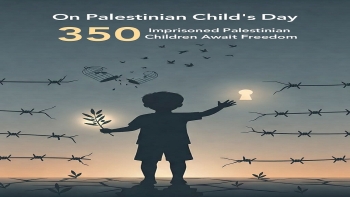
It's worth mentioning that 250 child are currently held in the prisons of the occupation, distributed in Ofer and Megiddo prisons.

ACTIVITIES AND EVENTS

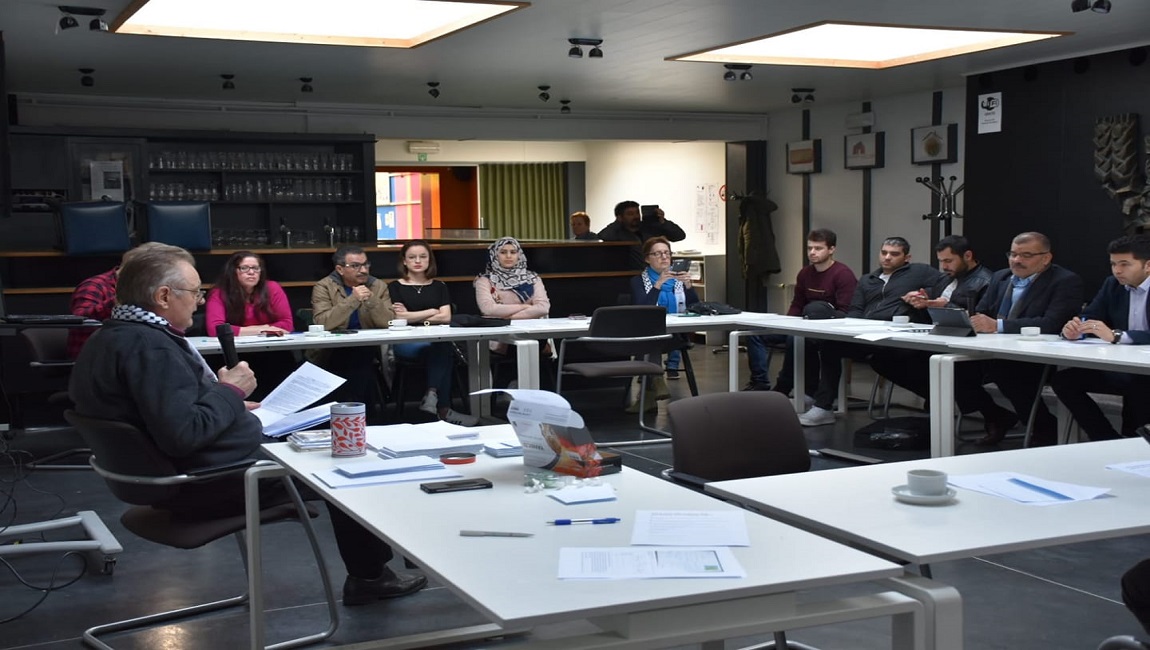
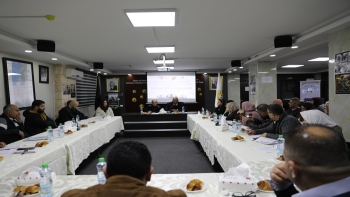
  • The Commission of Detainees Affairs organized a symposium on "The Israeli terrorism and racial laws against detainees". >

    Read More
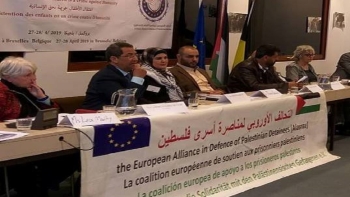
  • Abu Baker calls on the European Union to act immediately and hold Israel accountable for its crimes against the Palestinian detainees >

    Read More
  • The director of Media Department presents a paper on minor detainees in Brussels Conference >

    Read More
  • The Commission of Detainees' Affairs arranges a specialized workshop on house arrest against children from Jerusalem >

    Read More
  • 1

REPORTS AND ACHIEVEMENTS

  • International Women’s Day: 72 Palestinian Female Political Detainees in Israeli Occupation Prisons Face Abuse, Severe Violations >

    Read More
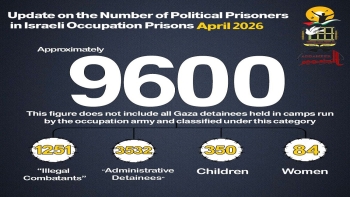
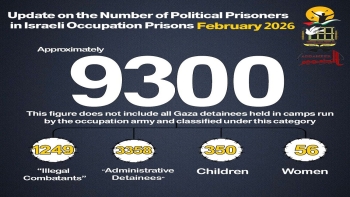
  • Update on the Number of Political Prisoners in Israeli Occupation Prisons – February 2026 >

    Read More
  • The Hidden Genocide: Thousands of Palestinian Political Prisoners Suffer Severe Crimes and Extermination Behind Bars - 
December 2025 Briefing >

    Read More
  • UPDATE: Palestinian Political Prisoners in Israeli Occupation’s Custody – December 2025 >

    Read More
  • 1