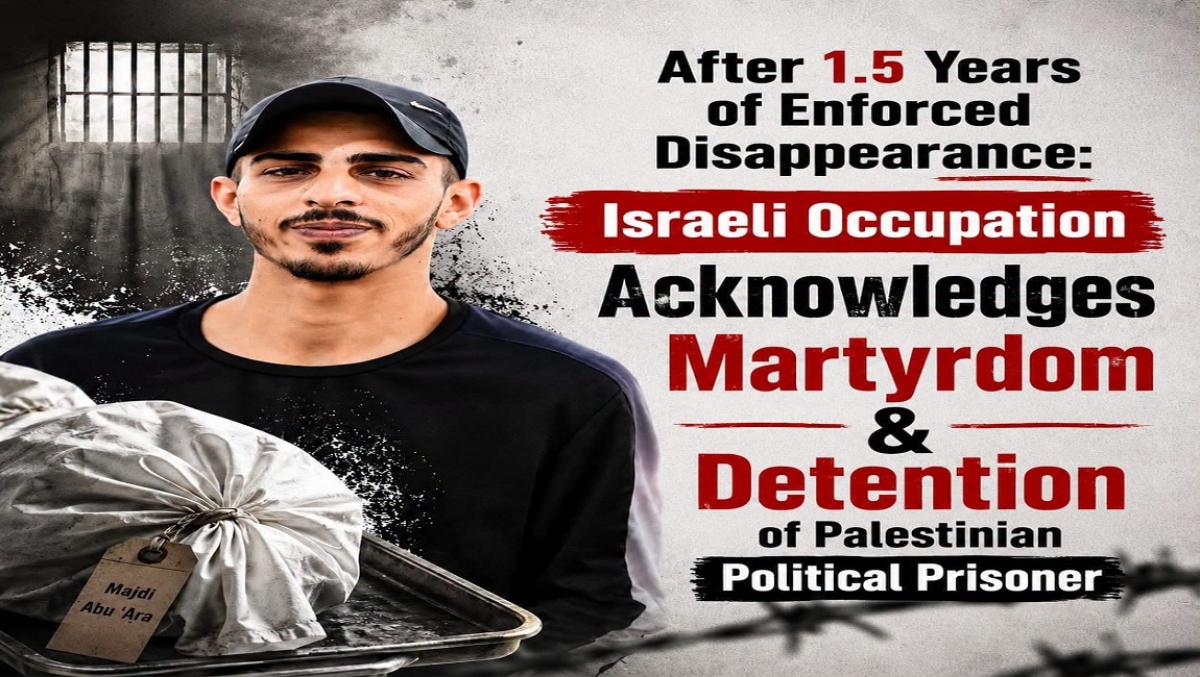



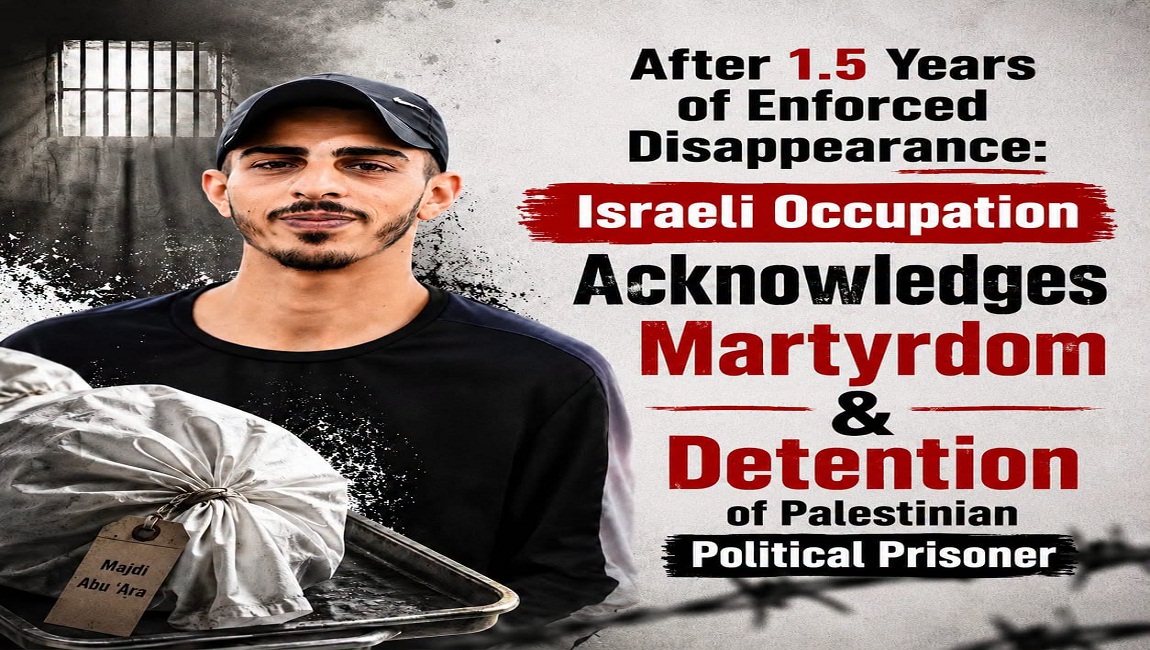
After 1.5 Years of Enforced Disappearance: Israeli Occupation Acknowledges Martyrdom & Detention of Palestinian Political Prisoner
*Statement Issued by the Commission of Detainees' Affairs and the Palestinian Prisoner’s Society*
*After 1.5 Years of Enforced Disappearance: Israeli Occupation Acknowledges Martyrdom & Detention of Palestinian Political Prisoner*
June 28, 2026
Ramallah, occupied Palestine - Israeli occupation authorities disclosed on Sunday, June 28, the martyrdom of the Palestinian political prisoner Majdi Noor Abu Arra from the Tubas area of the northern West Bank. This comes after occupation authorities forcibly concealed his fate for a year and a half, without disclosing the date or circumstances of his martyrdom, while continuing to detain his body.
In a joint statement, the Commission of Detainees’ Affairs and the Palestinian Prisoner's Society held occupation authorities completely responsible for his martyrdom, and emphasized that he was subjected to constitutes a full-fledged crime of enforced disappearance. This is the same crime that has been imposed on dozens of martyrs from the Gaza Strip whom the occupation arrested and refuses to disclose their fates.
The crime of enforced disappearance has emerged as one of the most serious issues that escalated following the war on the Gaza Strip.
Conversely, thousands of Palestinians remain missing, while the bodies of an unknown number of detained martyrs remain subject to enforced disappearance, given the occupation's continued blackout on their fate and its refusal to provide any information regarding them.
The two organizations pointed out that regarding martyrs from the West Bank, specialized institutions used to receive notifications related to the martyrdom of prisoners through the Palestinian General Authority for Civil Affairs within hours of their passing, with the exception of only two cases in which institutions were notified days after their martyrdom inside the occupation prisons.
This is in addition to the receipt of inaccurate information regarding the martyrdom and arrest of others. In a number of cases where Palestinian authorities were notified of the martyrdom of citizens, it later turned out that they were detained by the occupation, and that some had passed away while in captivity. This left their families in a state of shock, anxiety, and doubt regarding the fate of their children.
The two institutions reaffirmed that what the young man Majdi Abu Arra was subjected to is a full-fledged crime of enforced disappearance, especially since his family resorted throughout that entire period to various competent authorities to inquire about his fate with the occupation authorities, without receiving any response or information regarding his whereabouts or his legal and humanitarian status, until they were informed of his martyrdom today.
The two institutions stressed that the crime of enforced disappearance is one of the most serious crimes that Israel has escalated following the war. However, this does not mean it is a novel crime; historically, occupation authorities have consistently utilized this policy as a tool of repression and control, similar to all other crimes and violations committed against the Palestinian people, as part of an extended and deeply rooted colonial system in the context of the occupation of Palestine.