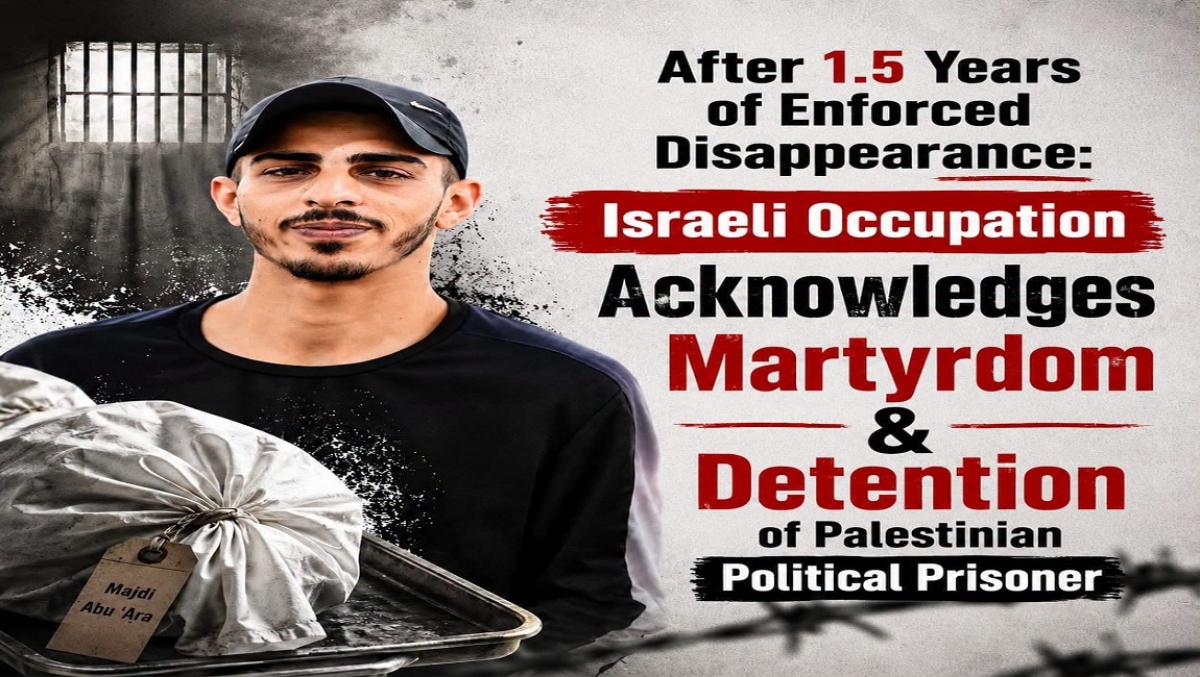
• After 1.5 Years of Enforced Disappearance: Israeli Occupation Acknowledges Martyrdom & Detention of Palestinian Political Prisoner

    After 1.5 Years of Enforced Disappearance: Israeli Occupation Acknowledges Martyrdom & Detention of Palestinian Political Prisoner

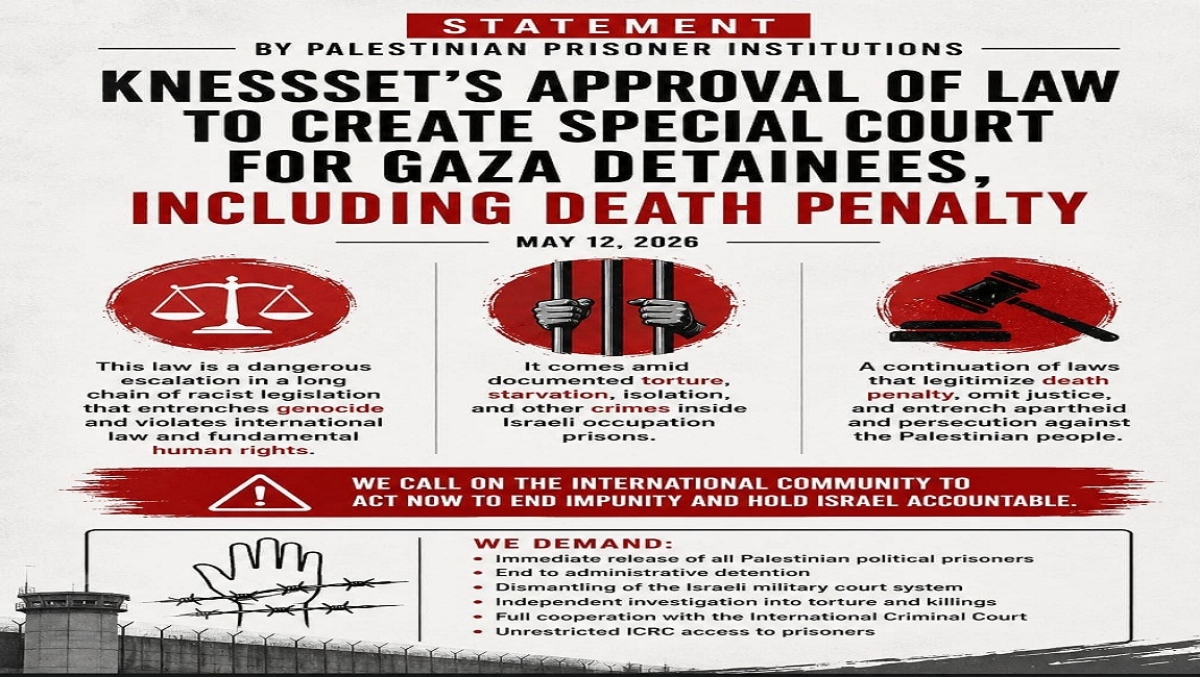
  • “Knesset’s” Approval of Law to Create Special Court for Gaza Detainees, Including Imposition of Death Penalty - Statement by Palestinian Prisoner Institutions

    “Knesset’s” Approval of Law to Create Special Court for Gaza Detainees, Including Imposition of Death Penalty - Statement by Palestinian Prisoner Institutions

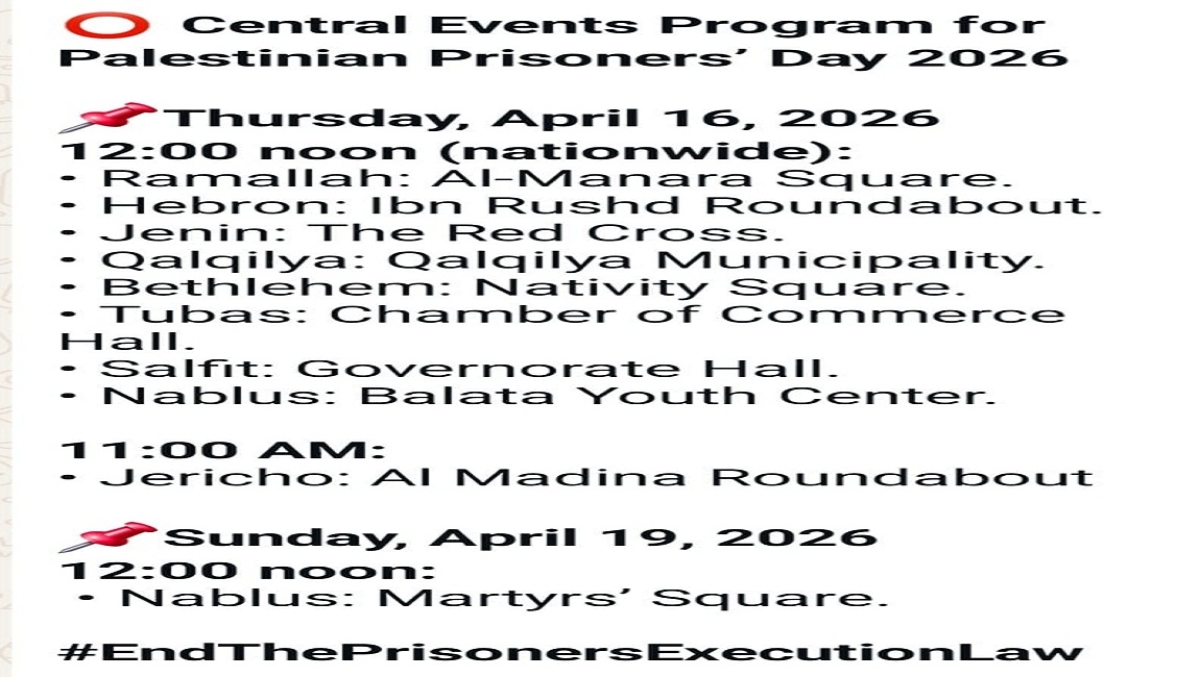
  •  Central Events Program for Palestinian Prisoners’ Day 2026

    Central Events Program for Palestinian Prisoners’ Day 2026

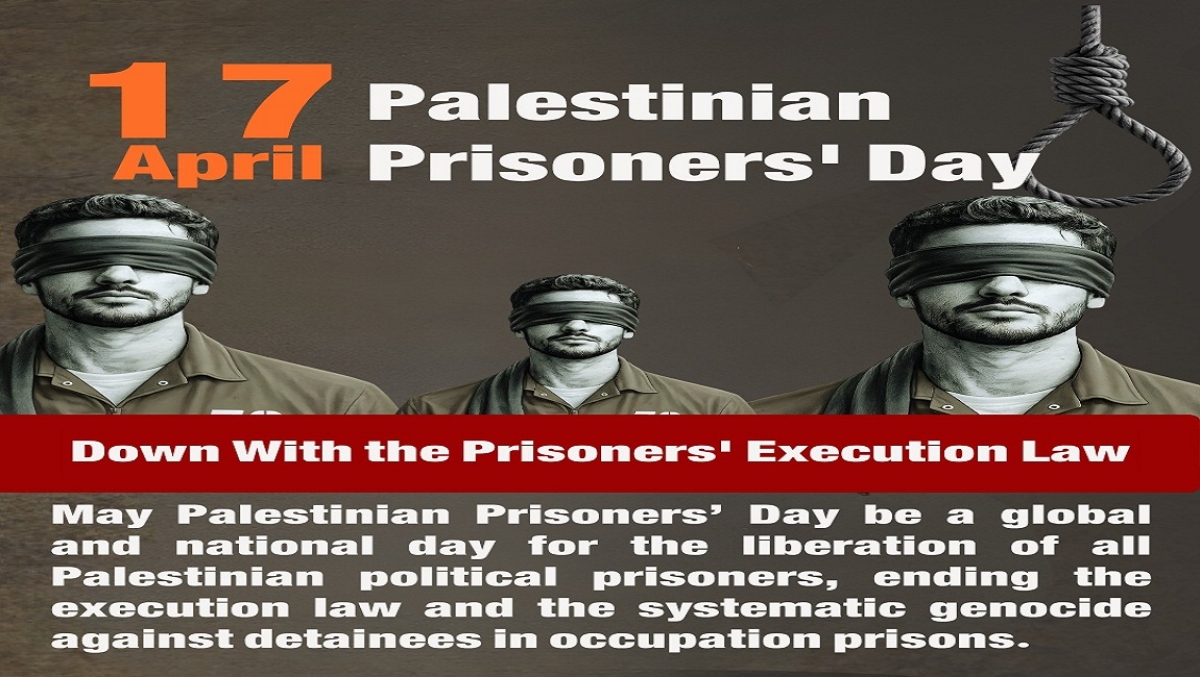
  • Palestinian Prisoners'  Day 2026

    Palestinian Prisoners' Day 2026

  • Invitation to Journalists and Media Outlets in Palestine

    Invitation to Journalists and Media Outlets in Palestine

  • 1
  • 2
  • 3
  • 4
  • 5

Ramallah: conferees announce launching the activities of the Palestinian Prisoner's Day

on . Posted in slider

17th of April,,, the national day of supporting detainees
One million detention cases among Palestinians since 1967
The occupation authorities arrest (1600) Palestinians through the first quarter of 2019
Ramallah: conferees announce launching the activities of the Palestinian Prisoner's Day
The Commission of Detainees and Ex-Detainees' Affairs, the Palestinian Society Prisoner's Club and the Supreme Commission of Detainees' Affairs called on the Palestinian people in various locations to participate actively in the activities scheduled for the Palestinian Prisoners' Day, corresponding April, 17 of each year.
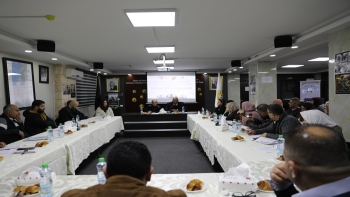
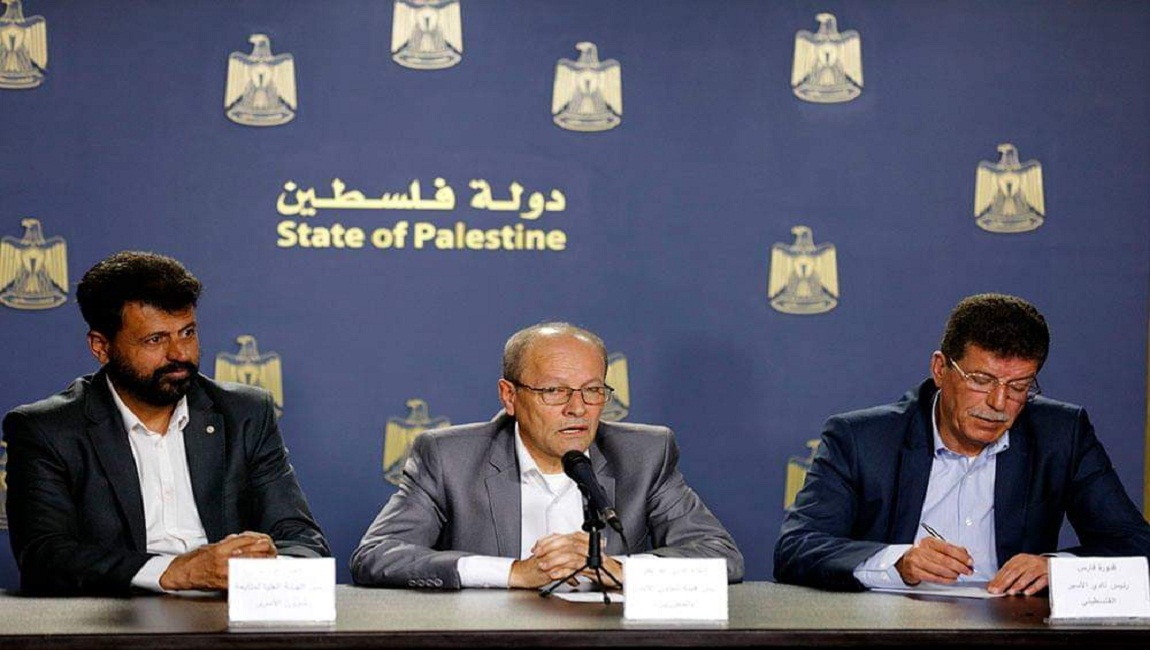
This came in a news conference held by the head of the Commission of Detainees and Ex-Detainees' Affairs Qadri Abu Baker,  the head of  the Palestinian Society Prisoner's Club Qaddura Fares and the head of Supreme Commission of Detainees' Affairs Amin Shouman to launch the activities of Palestinian Prisoner's Day of 2019. The conferees gave a presentation on the latest developments and the difficult situation experienced by the captive movement.
The Palestinian Prisoner's Day 2019
 The national and international day of supporting the Palestinian detainees in Israeli jails corresponds April 17 of each year, which was approved by the Palestinian National Counsel in honor of martyrs of the Captive Movement and detainees in Israeli jails to support them and their legitimate right to freedom.

Detainees' statistics until the end of March 2019
•    1.000.000 Palestinians have experienced detention since 1967
•    5700 are currently held in Israeli jails include:
•    250 child
•    36 minors from Jerusalem under house detention, and 5 in housing centers
•    47 females
•    6 representatives
•    500 administrative detainees
•    700 sick detainees arrested since more than 20 years
•    26 senior detainees arrested before the Oslo Accord, such as Maher Younes and Kareem Younes who were arrested since 37 years
•    570 detainees are sentenced to life imprisonment
•    218 martyrs from the Captive Movement have martyred since 1967 including: 73 detainees who martyred due to torture, 63 martyred due to medical negligence, 7 shot dead directly by soldiers and 78 martyred due to execution after being detained.
Occupation authorities arrested 1600 Palestinians during the first quarter of 2019
Since the beginning of 2019, the Israeli occupation authorities arrested 1600 Palestinians. The majority of them are from Jerusalem, including 230 minors and 40 females.
The Israeli occupation authorities resort to many policies and procedures during the process of detention, such as using excessive force during the arrests and extrajudicial executions, as well as the policy of collective punishment. This is what happened to Al-Barghouthi family from Ramallah, where the Israeli army has executed Saleh Barghouthi after arresting him on December 2018, and arrested 40 members of his family, including his father, mother, siblings and cousins. They broke into their house and opened fire inside and outside the house, wounding 3 citizens with live bullets and detaining 100 persons inside the house.
Moreover, Israeli authorities continued to arrest members of the Legislative Counsel, defenders of human rights, journalists, activists on Facebook, females and minors.
The first quarter of 2019 is the worst on detainees
Detainees' conditions in interrogation centers:
The administration of prisons carried out its suppressive policies aiming at destroying the Palestinian detainees and degrading their dignity. The interrogation is the first step of these policies using physical and psychological torture, starting from the first moment of detention. 95% of detainees have experienced detention.
A case in point is the detainee Asem Barghouthi, 33, who is arrested since 8/1/2019. He was subjected to cruel investigation which lasted for 14 days, by 20 hours per day. He was deprived of sleeping and prevented from meeting his lawyer for 22 days.
Another case in point is the detainee Zeyad Shalaldeh, 44, who was arrested with his son at the same day. He was exposed to torture during his detention, and he was injured all over his body. In addition, occupation forces used dogs when breaking into his tent and hit him with rifles.

The administration of prisons continued its suppression and humiliation against detainees after transferring them to central prisons. These policies are represented in isolation, fines, beating, destroying detainees' belongings and depriving hundreds of them of family visits. Moreover, detainees are deprived of medical treatment and health care through the policy of deliberate medical negligence.
Clamping down against detainees increased after approving the recommendations of "the committee of withdrawing the achievements of detainees" formed by the Minister of Internal Security Gilad Ardan. This committee confiscated thousands of books, decreasing the quantity of water, installing surveillance cameras and jamming devices and other procedures.
One of the most prominent procedures used by the occupation prisons is the sudden incursions and repeated inspections of rooms and cells.  Since the beginning of 2019, dozens of incursions have been carried out by repressive forces, such as "Nahshon, Yimaz, Dror and Al-mitsada". The most prominent of these were the incursions into the Ofer, Negev, Megiddo and Remon prisons.
In 20-21 January, 2019, Ofer prison witnessed a suppression process in which the Israeli forces used pepper gas, rubber coated bullets and sound bombs, where more than 150 detainees got injured.
In 21 Januray, 2019, the Israeli forces broke into section 2 at Megiddo prison, and then many breaks took place in Remon and Negev prisons, where a new battle started to confront the installing of jamming devices.
Confrontation increased between the detainees and the administration of Remon prison in March 2019, after breaking into section 7 and transferring detainees to section 1. The escalation aggravated on March 24, 2019 after breaking into section 4 using gas and sound bombs against detainees, which led to the injury of 120 detainees with different wounds such as fractures in the teeth, hands and pelvis, and wounds in the head, chest and eyes. However, the administration of prison held internal prosecutions and imposed fines up to NIS 12.000, and the administration still depriving them of medical treatment.
In order to control the detainees in last attack, the administration of Negev Prison summoned all Special Forces such as   Giv'ati battalion, in addition to martial units from the internal front.
Constant increase in the policy of systematic medical negligence
Under the state of abuse practiced by the prisons' administrations against detainees, the number of sick detainees in Israeli jails reached up to 700 who need immediate treatment. 30 of them have cancer and 14 of them are held in Al-Ramla prison clinic.
This policy is over used through systematic measures, which does not exclude any detainee. The urgent need of medical treatment is misused in an attempt to avenge them. Through the past years, the detainees' institutions followed up many cases in which their medical files were closed under the pretext that there is no cure. As a result, many detainees were either martyred or released after reaching a stage in which treatment is useless.
Medical negligence is represented in depriving detainees of treatment or medical checkups, putting him on the waiting list for months and years, giving the diagnoses after long periods and forcing them to pay for transferring them from civil hospitals to prisons.

Legislation of extreme racist laws against detainees
 Since the occupation of Palestine in 1948 and deporting its people, the Israeli occupation authorities have used the racist laws to tighten their control over the Palestinian people. Moreover, the Israeli authorities held martial courts in the territories occupied in 1967. Therefore, Palestinians have been subjected to several legal systems, so Palestinians living in the occupied territories in 1948 are subordinate to the Israeli law.
This tool extended to include Palestinian detainees in Israeli jails who were subordinate to Israeli laws in order to deprive them of their rights and trying to break their will and control them. These steps increased with the rise of the right-wing successive Israeli governments, the most criminal ones, which approved the law of execution against detainees, as well as the law of the trial of children under the age of 14 years, and the law of physical inspection without any suspicion.
The las law was the robbery of money paid by the Palestinian Liberation Organization to the families of martyrs and detainees. a law was approved to retain part of the financial benefits of the Palestinian Authority in 2018 equivalent to the allocations paid to the families of detainees and martyrs, which were estimated at one billion and one hundred million shekels per year.

Call for the widest participation in the activities of the Palestinian Prisoner's Day and providing international protection for detainees
The Commission of Detainees and Ex-Detainees Affairs, the Palestinian Society Prisoner's Club and the Supreme Commission of Detainees' Affairs called on our people to stand by the detainees and participate in the activities of the Palestinian Prisoner's Day. They also call on all Arabs and the free people of the world to support the Palestinian detainees in Israeli jails, provide an international protection for them and oblige Israel to respect the rules of the International Law and the International Humanitarian Law in dealing with detainees, and consider them freedom fighters.


Torturing Palestinian minors using dogs and solitary confinement

on . Posted in slider

Israel uses all means of torture against Palestinians, including dogs to attack or harm them, and in many times the Israeli forces take dogs in the Bosta "transportation" to intimidate them. It does not exclude Palestinian children, in a violation of all international conventions including the Anti-Torture Convention and the Convention on the Rights of the Child.
The Israeli Human Rights Center (Betselem) stressed that urging the Israeli soldiers to use dogs to attack Palestinians is part of the policy adopted in Israel. In some cases documented by Betselem, dogs refused to leave the detainees who are under arrest, and the trainers had to shock them to leave the victim.
The testimony of the minor Mohammad Hammad, 16, from Qalandia camp, who is held in Ofer prison
He was tortured by dogs
In 16/1/2019, the Israeli forces surrounded my house in Qalandia refugee camp, accompanied by huge and terrifying police dogs. When they entered the house and made sure it is me who are they looking for, they let two dogs to attack me and bite me. My family was unable to intervene, where soldiers were holding my family members in another corner of the house threating them with weapons.
Four soldiers attacked me and started to beat me all over my body, and the dogs kept biting me for 15 minutes, which causes many wounds and bruises all over my body.
Then, the soldiers handcuffed and blindfolded me and forced me to walk while I was bleeding.
They took me to to a settlement called "Kochav Ya'akov" located on the lands of Kafr Aqeb, I fell on the ground and they forced me to walk, and I when I was able to walk they dropped me on the ground and cursed me.
When I arrived at the settlement, they transferred me to Atarot Interrogation Center east of Jerusalem without giving me any treatment. During the transfer in a military car, soldiers continued beating and insulting me.
The detective beat me and forced me to confess that I threw stone on soldiers at Qalandia checkpoint, and forced me to sign an affidavit written in Hebrew. Then, they transferred me to Ofer prison, where detainees bandaged my wounds as I was not given any treatment by the Israelis.
 The Euro-Mediterranean Observer for Human Rights considered the use of dogs in detaining unarmed children and civilians is "torture" and "inhuman and degrading treatment" which is criminalized by international law, in particular the Fourth Geneva Convention of 1949 and the 1984 Convention against Torture. The Center called on the (UNICEF) to act immediately to protect Palestinian children and to practice pressure on the Israeli Government to stop this inhumane policy.
In recent years, Israel practices the policy of solitary confinement against Palestinian children aiming at obtaining confessions and collecting intelligence information about other persons. Israel also practices a policy of isolation as a punitive measure aimed at destabilizing these children and depriving them of their rights by communicating with the outside world, where they are prevented from seeing their lawyers, the Red Cross or their families during the period of isolation.
In accordance with rule 45 of the United Nations Standard Minimum Rules for the Treatment of Prisoners, it is prohibited to use solitary confinement against children.
Isolating a minor from Jerusalem at Al-Maskoubya for 15 days
The minor Ahmad Abu Ewais, 17 years
Ahmad was arrested near the Hebrew University of Jerusalem at around 9:00 pm, where there were clashes between soldiers and youths. Two police officers attacked him and pushed him into the car. They handcuffed him and beat him until he arrived at the police station on Salah al-Din Street. They left him without food or drink until 3:00 am, and then they took him to the interrogation room and remained there form 5 hours under beating, insult and threating. Ten, he got transferred to the isolation for 15 days, in a narrow and smelly cell, where he was unable to sit or sleep. He was given a rotten blanket and they intended to turn on the AC for 24 hours. He was sent to the police station to complete the interrogation. The interrogation lasted for many hours, and he was handcuffed to the chair. The interrogation included all kinds of physical and psychological humiliation. Then, he was transferred to Ovik prison in Jerusalem, which is dedicated for Israeli minor prisoners. He remained there for two weeks, where he was treated in a bad way by the Israeli civilian prisoners. After that, he was transferred to Megiddo prison upon the request of the of security detainees in Megiddo prison.
Isolating a minor from Jerusalem at Al-Maskoubya for 17 days
The minor Yousef Khaldon Izzat Salah, 17 years
Yousef was arrested from the downtown in Jerusalem during clashes with the police. He got transferred to Al-Maskoubya and was interrogated for long hours. Then, he was detained for 17 days in a narrow cell at Al-Maskoubya prison. He was subjected to physical and psychological torture during the interrogation, and he was handcuffed and beaten all the time. After the interrogation ended he was transferred to Megiddo prison at section 4 dedicated for minors.
Isolating a minor at Al-Maskoubya for 14 days in addition to 3 days at Ovik prison with Israeli civilians
The detainee Ameer Abdullah Mas'ood, 17, from Jerusalem
Ameer was arrested from his house in 16/8/2018 at 12:00 pm. The Israeli intelligence phoned his family and asked about him. They entered the house and took some of his clothes and arrested him. He was transferred to a police station on Salah Al-Deen Street. There, they inspected him and took him to the interrogation room for two hours. He then was transferred to Al- Maskoubya prison after the interrogation ended. He was held in the solitary confinement at Al-Maskoubya prison for 14 days and. After that, he got transferred to Ovik prison with Israeli civilians for 3 days and then he got moved to a prison for minors. He's currently held in minors' section at Megiddo prison and sentenced to 12 months of imprisonment and a fine of NIS 1500.
In isolating the Palestinian children, Israel violates all international conventions including the 1984 Convention against Torture and the 1989 Convention on the Rights of the Child.
Solitary confinement is a form of psychological torture, and it is an inhuman and degrading treatment method prohibited under article 7 of the International Covenant on Civil and Political Rights.
The circumstances in which Palestinian children are held do not fit the health standards set forth in articles 91 and 92 of the Fourth Geneva Convention relative to the treatment of civilian persons in armed Conflicts and Occupation.
The former Special Rapporteur of human rights in Palestine, Richard Falk, condemned the solitary confinement of Palestinian children, and described it as a form of cruel, degrading and inhuman treatment against minors, and that Israel violates the international human rights standards.

15 sick detainees at Al-Ramlah clinic are about to die at every moment

on . Posted in slider

The Commission of Detainees and Ex-Detainees' Affairs warned of the aggravated health conditions of sick detainees at Al-Ramlah clinic, who are facing death at a daily basis.
The Commission stated that 15 sick detainees are held Al-Ramlah clinic, suffering from poor health and medical conditions. Most of them have paralysis and move using wheelchair, depending on their colleges to help them.
In addition, the Commission affirmed that they are suffering from deliberate medical negligence, where medical services and health care are not provided. They are only given painkillers instead of being treated in a proper way.
The Commission reviewed the aggravated health condition of the detainee Sami Abu Dyak, whose health is deteriorating due to the cancer in the intestines since three years.
The advocate of the commission Fawaz Shalloudi visited Abu Dyak and cited his message, in which he states "for the sake of God, work seriously to release me because I am about to die, and I want to spend the rest of my life in my father's lap".
Cases of sick detainees at the clinic of Al-Ramlah prison are the most difficult, where there are injured and disabled detainees and other detainees who have chronic diseases due to the policy of medical negligence.
Sick detainees at Al-Ramlah clinic:

Normal 0 false false false EN-US X-NONE AR-SA /* Style Definitions */ table.MsoNormalTable {mso-style-name:"Table Normal"; mso-tstyle-rowband-size:0; mso-tstyle-colband-size:0; mso-style-noshow:yes; mso-style-priority:99; mso-style-parent:""; mso-padding-alt:0cm 5.4pt 0cm 5.4pt; mso-para-margin-top:0cm; mso-para-margin-right:0cm; mso-para-margin-bottom:10.0pt; mso-para-margin-left:0cm; line-height:115%; mso-pagination:widow-orphan; font-size:11.0pt; font-family:"Calibri","sans-serif"; mso-ascii-font-family:Calibri; mso-ascii-theme-font:minor-latin; mso-hansi-font-family:Calibri; mso-hansi-theme-font:minor-latin;} table.MsoTableGrid {mso-style-name:"Table Grid"; mso-tstyle-rowband-size:0; mso-tstyle-colband-size:0; mso-style-priority:59; mso-style-unhide:no; border:solid windowtext 1.0pt; mso-border-alt:solid windowtext .5pt; mso-padding-alt:0cm 5.4pt 0cm 5.4pt; mso-border-insideh:.5pt solid windowtext; mso-border-insidev:.5pt solid windowtext; mso-para-margin:0cm; mso-para-margin-bottom:.0001pt; mso-pagination:widow-orphan; font-size:11.0pt; font-family:"Calibri","sans-serif"; mso-ascii-font-family:Calibri; mso-ascii-theme-font:minor-latin; mso-hansi-font-family:Calibri; mso-hansi-theme-font:minor-latin;}


Name

City

Dwell time

Illness

Sentence

1

Khalid Shawish

Jenin

Permanent, using wheelchair

crippled

Life term

2

Naser Shawish

Jenin


Life term

3

Mansour Mouqade

Salfit

Permanent, using wheelchair

crippled

Life term

4

Ashraf Abu Alhuda

Nablus

Permanent

tumor in the testicles, and fragments in the pelvic area and spine

4 years

5

Mo'tasem Raddad

Tulkarem

Permanent

Intestinal cancer

20 years

6

Nahed Aqra'


Permanent, using wheelchair

crippled

3 life terms

7

Saleh Saleh

Nablus

Permanent, using wheelchair

paralysis

5 years

8

Mohammad Abu Khader

Jenin


Kidney problems

17 years

9

Sami Abu Dyak

Jenin

Permanent

Intestinal cancer

3 life terms

10

Ezz-Aldeen Karajat

Halhoul

Non-permanent

Using cane

Under arrest

11

Ahmad Abu Khdair

Jenin

Non-permanent

Not nick, but he helps sick detainees

11 life term

12

Iyad Hraibat

Hebron

Non-permanent

Using wheelchair

Life term

13

Mahmoud Abu Hwailah

Nablus

Non-permanent

Using cane

Under arrest

14

Mustafa Daraghmeh

Bethlehem

Non-permanent


Under arrest

15

Anas Mousa

Bethlehem

Non-permanent

Using wheelchair

Under arrest

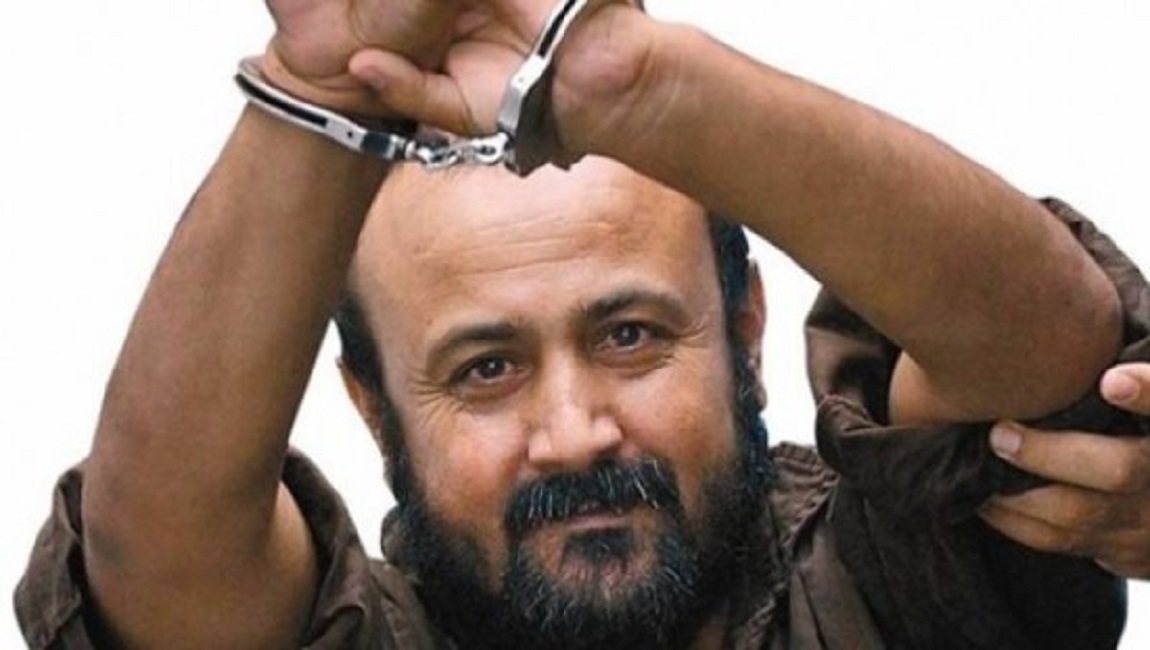
The leader Marwan Barghouthi enters his 18th year in Israeli jails

on . Posted in slider

The Commission of Detainees and Ex-Detainees Affairs stated that the representative of the Legislative Counsel and the member in the Central Committee of the Fatah Movement, the leader Marwan Barghouthi, enters his 18th years in jail, where he was abducted in 15/4/2002 and sentenced to 5 life sentences in addition to 40 years.
The report showed that Israel arrested the leader Marwan Barghouthi in 2002 when he was the secretary-general of the Fatah movement and a deputy member of the Palestinian Legislative Council. His arrest headed the international and even Israeli public opinion, which considered his arrest as a political detention and a war against the late president Yaser Arafat at that time.
Barghouthi was interrogated for 100 days in various detention centers such as Maskoubya, Betah Tekva, Jalameh and the confidential prison. The interrogation revolved around his relationship with Yaser Arafat and funding the Intifada activities, in an attempt to condemn the late president Yaser Arafat whom Sharon considered a non-partner and imposed a siege on his residence, destroyed the headquarters of the PA and reoccupied the Palestinian areas in a process called "protective wall."
The leader Marwan Barghouthi refused many time to recognize the legitimacy of the Israeli court, considering his detention "null and void" and he submitted an indictment against the Israeli policies. He made a heated debate in the Israeli community, who realized that his detention distorted the moral image of Israel. Many municipalities in the world, especially France put his picture in front of its doors. He became a national symbol of the National Liberation Movement and a defender of freedom and human justice.
The Commission pointed out that Barghouthi has obtained his doctoral degree from inside the prison, and that he led the educational process of detainees in Israeli jails to assure the national constants of the Palestinian people.
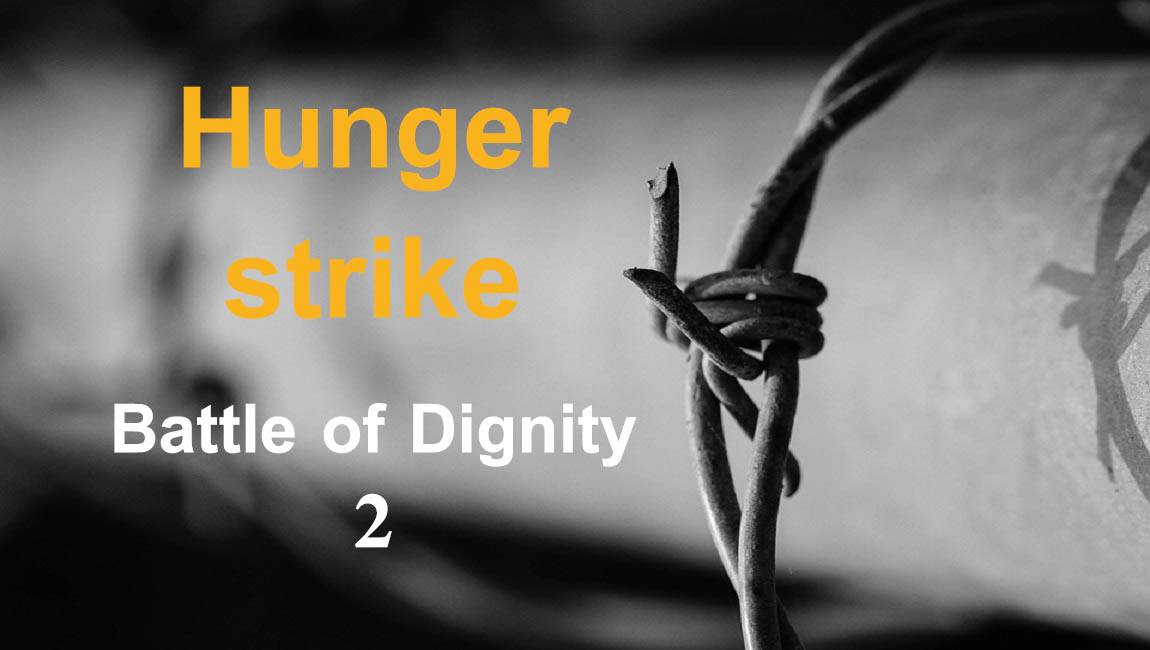
It is worthy to mention that Marwan Barghouthi led the dignity hunger strike in 2017 to unite the captive movement against the Israeli policies and violations. That strike included more than 1000 Palestinian detainees and lasted for 42 days, in which detainees were subjected to brutal attack by the Israeli authorities. 

Detainees declare the failure of conversations and 150 detainees enter an open hunger strike

on . Posted in slider

The Commission of Detainees and Ex=Detainees' Affairs declared the failure of conversations between the administration of the Israeli prisons and the representatives of the Captive Movement's factions in the Israeli prisons, after long hours of debate at Remon prison.
The Commission stated that 150 detainees entered an open hunger strike in Negev and Remon prisons in a battle called "the Battle of Dignity 2", and that many groups of detainees from various prisons will follow the strike in the coming days.
The Commission also stated that the conversations between the administration of prisons and the leaders of the Captive Movement had failed and arrived at a dead end. This failure came due to stubbornness of the prisons' administration in responding to the demands of the Captive Movement which are guaranteed by all international rules and regulations.
Detainees pointed out that the prisons' administration did not respond to the demands of the Captive movement such as removing the jamming devices, allowing family visits for detainees from Gaza, the lack of clear understandings on the installation of public telephone devices between prison sections, the continuity of isolating punished detainees in the recent events in Negev prison and stopping the breaking into sections, humiliation and medical negligence against them.
The detainees called on the Palestinian people to support their fair cause and their battle of struggle, in addition to supporting them with all possible means to expose the Israeli policies carried out against them, which contradicts all international laws and Human Rights principles

Detainees' institutions: occupation forces arrested (569) Palestinians in February 2019

on . Posted in slider

Ramallah: the occupation forces arrested (569) Palestinians from the occupied territories in February 2019, including (78) minors and (13) females.
Detainees' institutions and Human Rights Organizations (the Commission of Detainees and Ex-detainees' Affairs, the Palestinian Society Prisoner's Club, Al Dameer Association for Human Rights) pointed out in a fact sheet that the occupation authorities have arrested (229) citizens from Jerusalem, (73) from Ramllah and Al-Bireh, (60) from Hebron, (54) from Jenin, (44) from Bethlehem, (38) from Nablus, (15) from Tulkarem, (15) from Qalqilia, (9) from Tubas, (5) from Salfit, (10) from Jericho and (17) from Gaza Strip.
The most prominent policies practiced by occupation authorities against detainees in February:
Aggravated policies against detainees in Negev prison
Institutions observed a series of escalations by the occupation authorities and the Israeli prison Services that aimed to clampdown on the lives of Palestinian detainees in Israeli jails. Those escalations caused a state of tension that may increase and lead to unstable conditions in jails.
The wave of escalation started mid-February in Negev prison. At the beginning of the month, Negev prison administration informed the detainees about its intention to install jamming devices in section (4).
In February 15, the prison's administration emptied section (4) and installed the jammers. In February 18, the administration informed the detainees that it will operate the jammers at 10:00 am next morning. However, this notification came in spite of the negotiations with detainees that the jammers would not be operated. In response, the detainees informed the administration of the prison that they are willing to dissolve the factions and there will not be a representative of detainees to discuss matters with the administration, or take the responsibility of any action by the detainees. This action obliges the administration to deal with detainees individually, thereby keeping the prison administration in a permanent state of emergency.
This was the first step of protest which was followed by returning the meals by many sections, running at night in the prison's yard, and refusing to get inside their cells. However, the prison's administration responded by announcing the state of permanent emergency, doubling the numbers of forces and carrying out violent inspections in section (3&4).
The repression forces attacked detainees by beating them. In the same context, the detainees Ibrahim Natsheh and Fawzi Awwad burned their clothes, and then they were taken to solitary confinement, in addition to the detainee Saleh Ja'bari who also taken to solitary confinement after two days.
The escalations came after commencing the work of the committee formed by the Minister of Interior Security, Jel'ad Ardan, which aims to clampdown on the life conditions of detainees. The acts of the committee came in the context of the approaching Israeli elections, and in particular, the campaign by Israeli Prime Minister Binyamin Netanyahu who is using the Palestinian detainees as electoral propaganda.


Spoiled food served for detainees
Monitoring reports pointed out that the administration of prison is deliberately provide bad food in terms of quantity and quality for detainees in prisons and detention centers, where the food served does not conform to international laws and health standards, which force detainees to buy their stuff from the cantina on their own expenses.
Detainees' institutions revealed during last February that the suffering increases in detention centers, especially (Itzion, Huwara and Al- Jalama), where those detention centers do not contain a cantina, thus, detainees are forced to eat the bad meals of prison.

The institution of (Senior Prisoners in South Africa) is united in solidarity with the Palestinian detainees in Israeli jails

on . Posted in slider

The secretary of the institution of Senior Prisoners in South Africa, Mpho Mosimala, condemned the inhuman treatment and the immoral policies carried out against Palestinian detainees in Israeli jails.
He stated "we stress our condemnation of the barbaric and inhuman treatment and using torture against Palestinian detainees in the racist Israeli jails, where they are facing brutal physical and psychological torture".
He added: "our experience through the period of struggle against Apartheid is very similar to the circumstances of the detention of Palestinian detainees in Israel, especially during solitary confinement, and other matters such as nutrition, refusing or allowing meeting the doctors, as well as preventing reading books".
"We in the Institution of Senior Prisoners in South Africa condemn all the practices carried out against the detainees in the Negev prison about two weeks ago to clamp down on the detainees."
Mosimala called on the racist Israeli Prime Minister to release all detainees without any condition, especially females and children, put an end to house demolishing and start the negotiations on the basis of a two-state solution.
He ended his letter stating "we pay tribute to the struggle of the Palestinian people against all forms of fascism, and we support the Palestinian struggle. We pay tribute to the spirit of revolution of all Palestinian detainees who spent long time in the Israeli jails.
The Commission of Detainees and Ex-detainees' Affairs praised the historic attitude of the South African government in standing by the Palestinian people and the cause of detainees in the Israeli occupation jails, as well as the special national role played by the Embassy of the State of Palestine in South Africa with all its staff and employees in raising the cause of detainees at all levels. 

Urgent letter to the Human Rights organizations and the International Community on the conditions of Negev prison

on . Posted in slider

The occupying state is practicing repression against Palestinian detainees in the Israeli jails in the past few months, where Ofer prison witnessed unprecedented attacks of its sections in which jailers used gas and sound bombs in addition to rubber coated bullets. This act led to the injury of 150 detainees who have been taken to hospitals or to the clinic of the prison.
The repressive policy carried out by the prison services seems to conform to the recommendations of Jel'aad Ardan "the Minister of the internal security" which requested to suppress the Palestinian detainees.
During the past weeks, the administration of prisons installed jammers in the sections of Negev prison under the pretext that the Palestinian detainees have mobile devices. However, Palestinian detainees started to complain about the effects caused by the waves and radiations of this device. Yesterday, the Israeli forces broke into section 4 at Negev prison and started to transfer detainees to section 3. Tension prevailed at section 7, where news reported that the process of transfer was accompanied by violence against detainees. Detainees tried to defend themselves, and they were repressed by the prison services that used gas and sound bombs and rubber coated bullets. Furthermore, many detainees got wounded such as Isalm Yousri and Oday Salem.
 The Israeli forces kept some of the detainees handcuffed all over the night in section 3, 4, and 7. However, the situation in Negev prison got worse, where the attacks began in section 21, 22 and 23.
We in the Commission of Detainees and Ex-Detainees' Affairs realize the seriousness of the incidents in Negev prison, where 1300 Palestinian detainees are held in cruel conditions. In addition, we believe that the attacks practiced against our detainees emphasize the dangerous and repressive policy carried out by the prisons' services. We call on you and you organizations to work and intervene immediately to lift the injustice and save our detainees.
Best regards
 
Qadri Abu Baker
The head of the Commission of Detainees and Ex-Detainees' Affairs 
 

Al-Shobaki turns 80 years inside the Israeli jails

on . Posted in slider

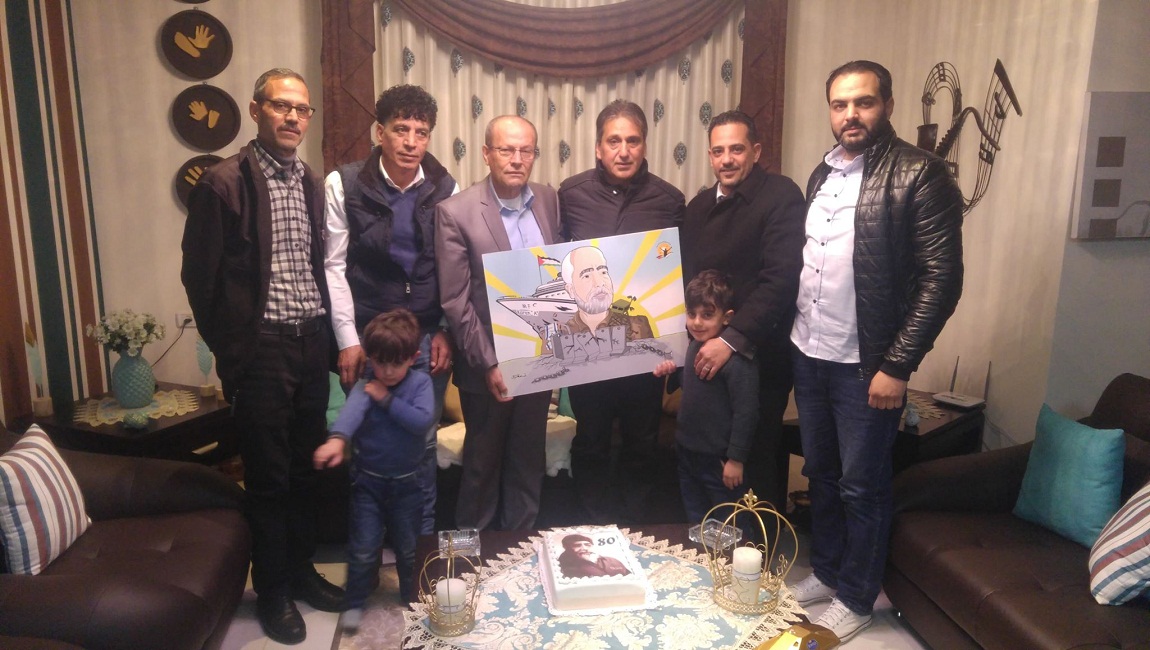
The Commission of Detainees and Ex-Detainees' Affairs stated on Tuesday that Major General Fuad Al-Shobaki the oldest Palestinian detainee in the Israeli jails has turned 80 years.
The Head of the Commission of Detainees' Affairs Qadri Abu Baker, the member of the Central Committee of Fatah Movement Muhammad Al-Madani, Dr. Muhammad Odeh, Reyad Qasrawi and Al-Shobaki's family has lighted a candle of freedom celebrating his 80th birthday. The cartoonist Ossama Nazzal made a portrait for him in this occasion.
Abu Baker stated: "Abu Hazem the oldest detainee in Israeli jails is sentenced to 20 years of imprisonment and he is detained since 2006. He suffers from many diseases and he was exposed to a deliberate medical negligence. The occupation bears full responsibility for his life, especially after refusing to release him, despite recognizing the deterioration of his health condition".
Abu Baker added "it is a shame on all the free people all over the world that Al-Shobaki enters his 80th year in the Israeli jails, while they just watch without taking a serious action towards the violations that he and all detainees are exposed to".
The Commission pointed out that the Military Court of Ofer Prison decided on September 2015 to mitigate his sentence by deducting three years of the sentence to be 17 years of imprisonment. Another session has been held on May 2018 to hear the final sentence, but it was postponed.   

ACTIVITIES AND EVENTS

  • The Commission of Detainees Affairs organized a symposium on "The Israeli terrorism and racial laws against detainees". >

    Read More
  • Abu Baker calls on the European Union to act immediately and hold Israel accountable for its crimes against the Palestinian detainees >

    Read More
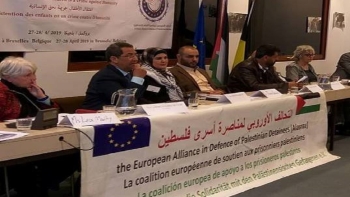
  • The director of Media Department presents a paper on minor detainees in Brussels Conference >

    Read More
  • The Commission of Detainees' Affairs arranges a specialized workshop on house arrest against children from Jerusalem >

    Read More
  • 1

REPORTS AND ACHIEVEMENTS

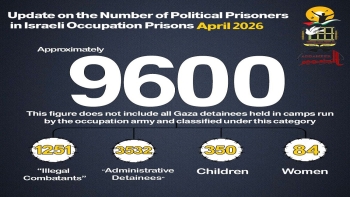
  • April 2026 Update on Numbers of Palestinian Political Detainees in Israeli Occupation’s Prisons >

    Read More
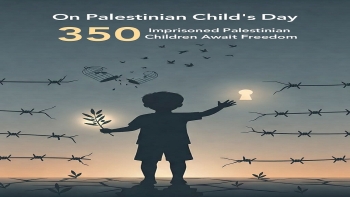
  • Palestinian Child’s Day Highlights Escalating, Systematic Targeting of Palestinian Children >

    Read More
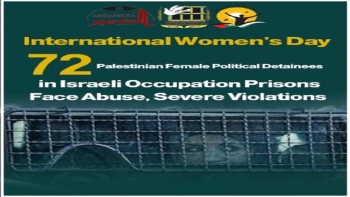
  • International Women’s Day: 72 Palestinian Female Political Detainees in Israeli Occupation Prisons Face Abuse, Severe Violations >

    Read More
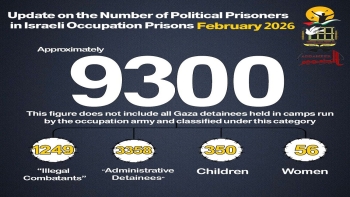
  • Update on the Number of Political Prisoners in Israeli Occupation Prisons – February 2026 >

    Read More
  • 1