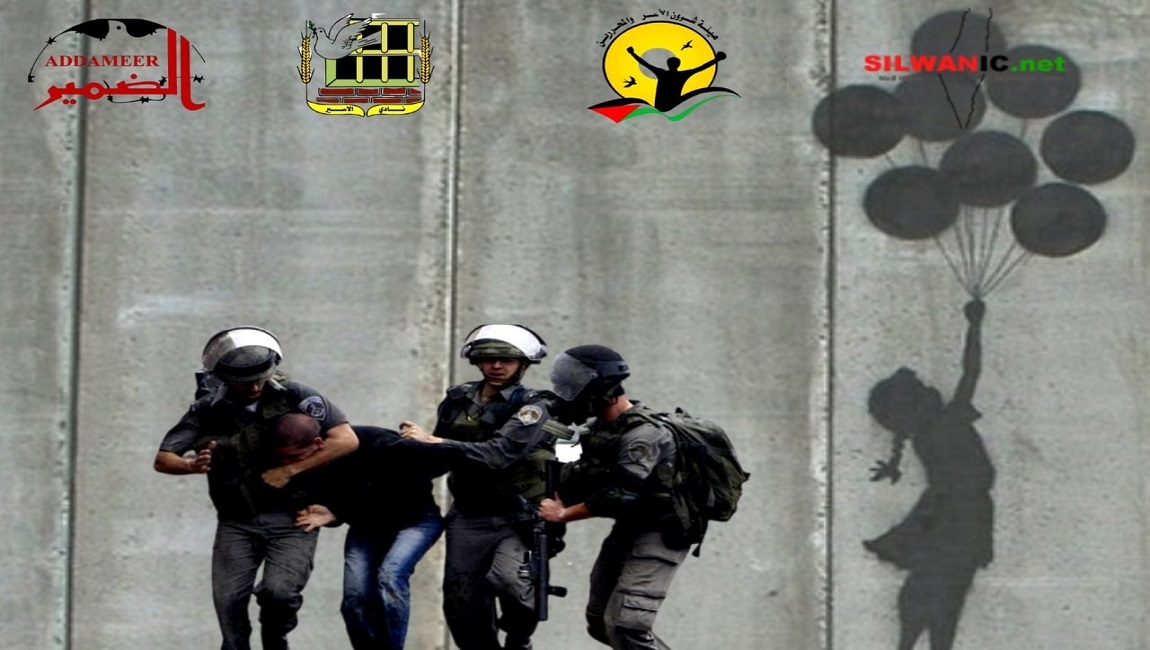
Detainees' Institutions: occupation authorities arrested (402) Palestinians in April 2021, including (198) from Jerusalem
The Israeli occupation forces have arrested (204) Palestinians in April 2021, including (61) child, (7) women and (100) administration detention orders.
According to the human rights organizations specialized in detainees' affairs, the Israeli authorities continue the systematic abusive policies at different levels and escalated the operations of violation and suppression against detainees in Israeli prisons.
(198) arrest cases have been recorded in Jerusalem, which is the highest rate compared to the few past months, where the Israeli occupation authorities have escalated suppression and violation operations against people of Jerusalem, especially at Al-Amoud Gate, Al-Aqsa Mosque and Shiekh Jarrah district.
March 2020, including (48) minors and (4) women.
Detainees' institutions and human rights organizations (the Commission of Detainees and Ex-detainees' Affairs, the Palestinian Society Prisoner's Club, Al Dameer Association for Human Rights and Wadi Hilweh Information Center- Jerusalem) pointed out that the total number of detainees in Israeli prisons until April 2021 is nearly (4400) detainees, including (39) women, (60) child and (430) administrative detainees.
The report exposes many policies implemented by the Israeli authorities, such as the increasing arrest campaigns in Jerusalem and the abusive actions which accompany these arrests, the issue of hunger strike that increased in April/ the case of the detainee Sawarkeh, the violation of journalists freedom and detaining them/the case of the detainee Alaa Rimawi, in addition to the issue of the detainee Muhammad Halabi, who is facing the longest trial in the history of the Captive Movement, since he appeared before 159 trials since 2016.
Jerusalem: increase in torture and arrest cases
The Israeli authorities escalated the attacks against the people of Jerusalem in April, especially with the beginning of Ramadan, where Al-Amoud Gate headed the clashes in the city after installing iron barriers on its stairs to prevent Palestinians from setting there during Ramadan. The yard of Al-Amoud Gate turned into a clashing point and extended to the adjacent streets, neighborhoods and towns of Jerusalem.
The occupation forces carried out tens of arrest cases and attacks during the protests at Al-Amoud Gate, and turned into a military outpost by spreading the Israeli Special Forces, army, police officers horsemen teams, intelligence device and wastewater vehicles.
The clashes increased in April 22 , after the extremist right wing Lehava Organization called the settlers to make marches to "defend the Jewish honor". The people of Jerusalem defended the city and prevented settlers from getting to Al-Amoud Gate. Meanwhile, settlers chanted racist slogans against Arabs, raised Israeli flags, and carried out attacks with stones and sticks against Jerusalemites. Racism was obvious in the Israeli police’s dealings with both parties, as they used force and violence against Palestinian guys, while avoiding any contact with settlers.
(198) arrest cases have been recorded, including (106) arrested from Al-Amuod gate, Al-Sahera Gate, Sultan Suleman street, Salah Al-Deen street and Al-Mesrarah. The detained people included 3 females, and 42 minors ranging between 12-15 years old.
Arresting a father and his two sons
3 of Salah's family " Khaldoun Salah and his sons Yousef and Ali", have been attacked while setting near Al-Amoud gate. Special Forces pushed them and attacked them with beat, and then arrested them.
Salah said "I told the soldiers many times that my son Ali (22 years) is totally blind, but they did not care about that and did not stop beating him. They used their rifles, hand and legs and pepper gas while attacking us and then they handcuffed us".
Then, they got moved to Salah Al-Deen police station, and the father was moved to hospital due to the hypertension and was released the next day.
Palestinian journalists facing the systematic arrest operations/ the case of the detainee Alaa Rimawi
The Israeli occupation forces arrested journalist Alaa al-Rimawi from Ramallah on April 21, 2021, due to his work as a journalist, and at the beginning of his arrest and before the issuance of an administrative detention order against him, he was accused of being "an influencer", and he announced his hunger strike from the first day of his arrest, protesting against his arbitrary arrest.
The occupation authorities detained Rimawi in the "Etzion" detention center in difficult and harsh conditions, as this center is the most prominent abuse tool used by the occupation authorities against detainees, where it is considered the worst detention center besides to the "Huwara" center. The harsh conditions of detention caused the deterioration of his health conditions and he was moved to one of the central clinics of the prisons' administration. He then got moved to Ofer prison, and then to solitary confinement, and then sentenced to 3 months of administrative detention.
Many trial sessions were held for the detainee Rimawi, and in his last session, on the 16th day of his open hunger strike, the court decided to shorten the period of his administrative detention order, to a month and a half, so that his administrative detention would not be extended. Later, he suspended his hunger strike.
The policy of hunger strike comes to confront the policy of administrative detention, which the occupation pursues to keep Palestinians in prison under the pretext of the existence of a "confidential file" that the detainee or his lawyer cannot access.
In an attempt to restrict the work of journalists on social media, the occupation started to convict them under the pretext of incitement on Facebook since 2014.
However, people around the world celebrate the International Press Freedom Day every year in the third of May, which was approved after the General Assembly of the United Nations announced in 1991 under a recommendation by the UNESCO.
The Israeli authorities tend to suppress journalists an prevent them from exposing the violations they commit against Palestinians, and also shoot them and arrest them in many occasions.
16 journalists are currently held in Israeli prisons, including 4 under the administrative detention.
The detainees' institutions consider that attacking journalists, being defenders of human rights, contradicts all international agreements and conventions, and violates article 23 of the Universal Declaration of Human Rights, which stipulates the right of freedom of expression and opinion.
Where the occupation authorities prevent journalists from practicing their profession freely, by criminalizing their work as journalists, and targeting them in an attempt to dissuade them from exposing the crimes and violations of the occupation, which violates article 19 of the International Covenant on Political and Civil Rights, and articles 1 and 2 which affirm the freedom of every human being Hold opinions without harassment, and the right to access, receive and impart information and ideas to others, whether in written or printed form or any other means.
Hunger strike is the continuous confrontation method/ the case of the detainee Imad Sawarke
The detainee Imad Sawarke (37 years) from Jericho continues his hunger strike since (55) days, protesting against his administrative detention. He suffers from difficult health conditions after losing (20 kgs) at Al-Ramla clinic.
In return for the continuation in his hunger strike, the occupation authorities continue their refusal in responding to his demands to end his administrative detention, despite the deterioration in his health conditions. there are still no serious solutions regarding his case, and the occupation authorities aim, through the procrastination process, to bring the detainee to a dangerous health stage.
His hunger strike is an important stage in confronting the administrative detention, in light of the increasing issuance of administrative detention orders, where 100 orders have been issued since the beginning of this year.
Sawarke is married and has five children, and he faced many arrest cases which reached to ten years.
Many detainee entered a hunger strike besides Sawarke, including Saed Abu Obaid, Musaab Alhour, Muhannad Azzeh and the journalist Alaa Rimawi.
The intelligence device of the occupation issued (400) administrative detention orders since the beginning of 2021.
Since 2011 and 2012 till this day, tens of detainees entered hunger strike to protest against the administrative detention, including the collective strike in 2014 which lasted for (62) days.
Moot Courts/ the case of the detainee Muhammad Halabi and the longest trial in the history of the Captive Movement
The detainee Muhammad Halabi (43 years) from Gaza still facing the longest trial till the issuance of this report, where he appeared before 159 trials in front of the Israeli Judiciary.
What happened with him shows the crimes of the trials carried out by the Israeli Judiciary against thousands of Palestinian detainees, which is far away from the standards of fair trial. It also confirms the racism of the judiciary system in Israeli.
Halabi has been arrested in June 2016, and was moved to Ashkelon interrogation center for (52) days, in which he was subjected to physical and psychological torture,a nd he was prevented from meeting his lawyer, in an attempt to practice pressure on him to confess guilt.
Halabi suffers from 50% hearing loss and other problems, and despite the international and human rights organizations'' calls for releasing him, the Israeli occupation authorities still continue its crime and detaining and torturing him.
Detainees' institutions confirm that the continuous crimes of the occupation need an assertive stance by the international community and serious measures that force the Israeli authorities to stop its systematic crimes.