Detainees of the Captive Movement
June 1, 2025
Detainees of the Captive Movement
Today marks the 604th day of the Israeli war on the Gaza Strip, a war that has become one of the most brutal genocides in modern history. Nearly two million Palestinians in Gaza remain trapped under relentless bombardment, starvation, siege, and the looming threat of forced displacement. With no protection and no weapons, they stand alone against a ruthless occupying power, while the world watches in disgraceful silence. To date, this war has left behind almost 55,000 martyrs, over 130,000 injured, and more than two million forcibly displaced, and the bloodshed continues without pause.
Inside the prisons of the Israeli occupation, over 10,000 Palestinians are currently detained, including 45 women, more than 400 children, and approximately 3,577 administrative detainees held without charge or trial. Among them are at least 1,846 detainees from Gaza, classified under the unjust and illegal label of “unlawful combatants”, a designation created by Israeli law to justify indefinite detention of civilians without due process, without evidence, and without fair trial, based on so-called "secret files" withheld even from legal counsel. The exact number of Gaza’s detainees remains unknown due to Israel’s systematic practice of enforced disappearance.
This report exposes a grave and escalating crisis: the growing number of martyrs within the Palestinian Captive Movement, particularly since October 7, 2023. While the suffering of Palestinian detainees has been ongoing for decades, through torture, humiliation, and medical neglect, the post-October 7 period has seen an unprecedented surge in violence, cruelty, and death. Since the start of this war, 70 Palestinian detainees have been killed in Israeli custody, bringing the total number of detainees martyrs to 307. Since1967 to just before October 2023, the number of martyrs from the Captive Movement was 237, averaging four per year. In contrast, the past two years have seen a tenfold annual increase.
These martyrs have died under torture, starvation, sexual abuse, and deliberate medical neglect. Many were exposed to horrific conditions designed to weaken and slowly kill, including filthy, overcrowded cells that became breeding grounds for infectious diseases, such as scabies, and other chronic, untreated illnesses.
The findings in this report are based on verified information and official correspondence with Israeli authorities, who have repeatedly attempted to manipulate the truth by providing contradictory, misleading, and false data. They continue to withhold the bodies of martyrs and hide the circumstances of their deaths in an effort to erase evidence of their crimes.
Martyrs of the Captive Movement since 1967:
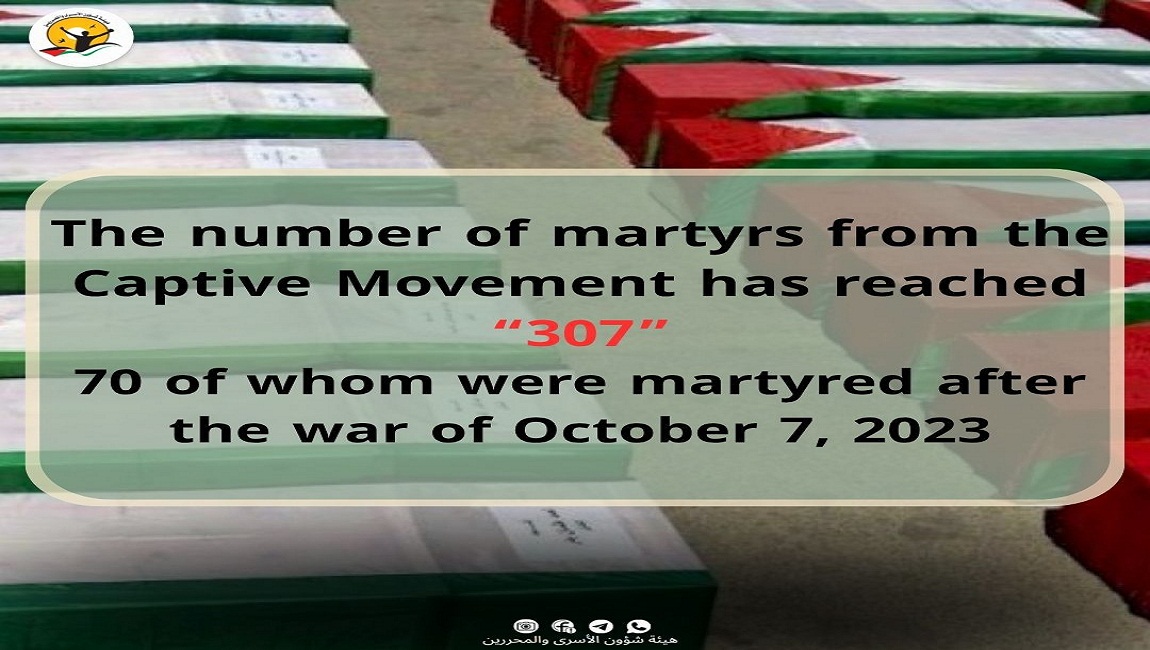
The number of martyrs from the Captive Movement has reached 307 as of the writing of this report, including 70 martyrs who died after the genocide war (October 7, 2023), representing 23% of the total number of martyrs in the Captive Movement.
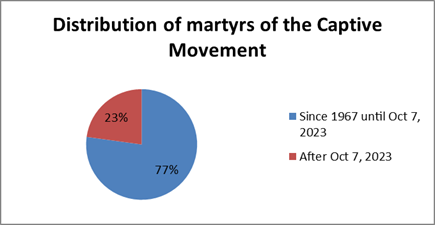
This report will highlight the 70 detainee martyrs who died after October 7, 2023, as it is the most brutal period in the history of the captive movement, in order to shed light on the crimes committed by the occupation against our detainees, as outlined below.
Relative distribution of martyrs by region (after the October 7 war):
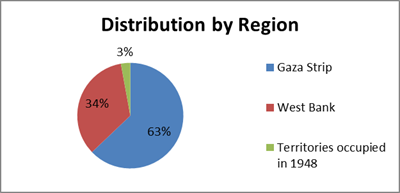
The chart above shows that the majority of martyrs, 44 in total, accounting for 63%, are from the Gaza Strip. The West Bank follows with 24 martyrs, representing 34% of the total (including one from Jerusalem). Meanwhile, 2 martyrs, 3%, are from the occupied territories within the 1948 borders.
Relative distribution of martyrs by the date of martyrdom (after the October 7 war):
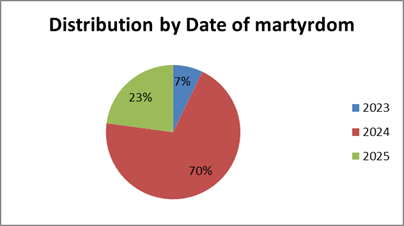
As shown in the chart above, detainees' organizations reported the deaths of 5 detainees in 2023, accounting for 7% of the total. In 2024, the number rose sharply to 49, making up 70%, marking it as the deadliest year in the history of the captive movement. In the current year, up to the date of this report, 16 detainees have been declared martyred, representing 23%.
Note: The date of announcement does not necessarily coincide with the actual date of death. These announcements are typically based on official responses from Israeli occupation authorities, who are known to routinely obscure facts in an attempt to cover up their crimes.
Relative distribution of martyrs by age (after the October 7 war)
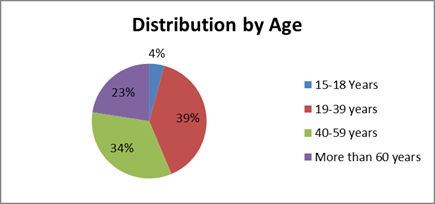
Based on the chart above and available data for 66 out of the 70 martyrs after October 7, the age distribution is as follows:
- Minors (ages 15–18): 3 martyrs, making up 4%.
- Young adults (ages 19–39): 28 martyrs, comprising the largest group at 39%.
- Adults (ages 40–59): 24 martyrs, accounting for 34%.
- Elderly (60 years and older): 11 martyrs, representing 23%.
This distribution underscores the severity of the occupation’s crimes against detainees, particularly minors and the elderly, who together represent around 27% of the total. This notably high percentage serves as a troubling indicator of the brutality directed toward the most physically vulnerable age groups inside prisons.
Relative distribution of the martyrs based on the duration between arrest and martyrdom (after the October 7 war):
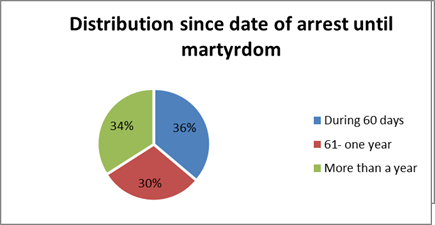
Among the 47 documented cases out of 70 martyrs following October 7, the chart above reveals that 36% (17 detainees) died within the first 60 days of their arrest. This strongly suggests that they were subjected to severe torture, inhumane treatment, and systematic abuse during interrogation, ultimately leading to their deaths.
Additionally, 30% (14 detainees) lost their lives between two months and one year after being detained. The remaining 34% (16 detainees) were martyred after spending over a year in captivity. These figures reflect the prolonged and escalating brutality faced by Palestinian detainees in Israeli prisons.
Relative distribution of the martyrs by place of detention (after the October 7 war)
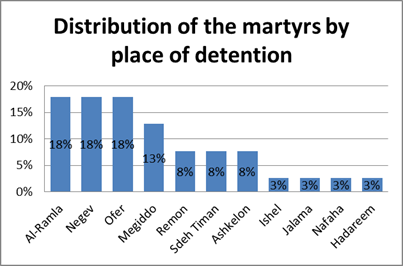
According to data available data on 39 out of the 70 martyrs who died after October 7, the most lethal detention centers were Ramla, Ofer, and Negev prisons, which alone were responsible for over half of the recorded deaths—21 martyrs, or 54%, with each facility accounting for 7 deaths (18%). This alarming concentration of deaths in specific prisons serves as a stark warning and a call to action for international human rights organizations to confront their obligations and hold the occupying authorities accountable.
Following these, Megiddo Prison recorded 5 deaths (13%), while Ramon, Sdeh Teiman, and Ashkelon prisons each witnessed 3 deaths (8%). The remaining deaths occurred across various other prisons, each contributing 1 martyr (3%). These figures expose a deeply rooted and systematic pattern of abuse and negligence within Israel’s prison system, demanding urgent international scrutiny and intervention.
Additional information:
- Of the 70 detainee martyrs who died after October 7, 2023, 17 were already suffering from injuries, chronic illnesses, or disabilities at the time of their arrest, accounting for 24% of the total. Among them were three cancer patients and one with kidney disease. These figures point to a deliberate policy of medical neglect, aimed at slow execution through systematic denial of treatment, an egregious violation of international humanitarian law.
- Included in the list of martyrs are four medical personnel, all from Gaza. This group comprises three physicians—Dr. Adnan Ahmad Atiya Al-Barsh, Dr. Iyad Ahmad Mohammad Al-Rantisi, and Dr. Ziyad Mohammad Saleh Al-Dalu—as well as a paramedic officer, Hamdan Hassan Anabah. All four were tortured to death, underscoring the brutal targeting of healthcare professionals by the occupying forces.
- Furthermore, 8 out of the 70 martyrs were held under administrative detention, imprisoned without formal charges or trial, making up 11% of the total. Their deaths highlight the deadly consequences of this unlawful and arbitrary detention policy.
- As of this report, the Israeli occupation continues to withhold the bodies of 79 martyred prisoners, including 68 of the 70 who died after October 7. This ongoing practice of body retention represents not only a violation of human dignity but also a cruel tactic of psychological warfare against the victims’ families.
We reaffirm that the findings in this report are derived from the limited information publicly available and from official statements issued by the occupation’s authorities. What remains concealed is likely far more horrific. This report does not imply that one prison is more brutal than another; rather, it exposes a cohesive system of repression—a single apparatus of violence governed by a unified policy of systematic abuse. The crime is the occupation itself.
The results presented here stand as a damning indictment of the international human rights and humanitarian community, which has failed miserably in its moral and legal obligations toward Palestinian prisoners. Since the launch of the genocidal war on October 7, 2023, not a single meaningful visit has been conducted to any Israeli prison, nor has the occupation been held accountable for its escalating crimes. International conventions that recognize prisoners of liberation movements have been willfully ignored.
In light of this utter inaction, we cannot help but question the credibility, independence, and integrity of these institutions. Their silence, neglect, and passivity raise serious concerns about their complicity—and their submission to the will of the occupying regime.
(End of Report)