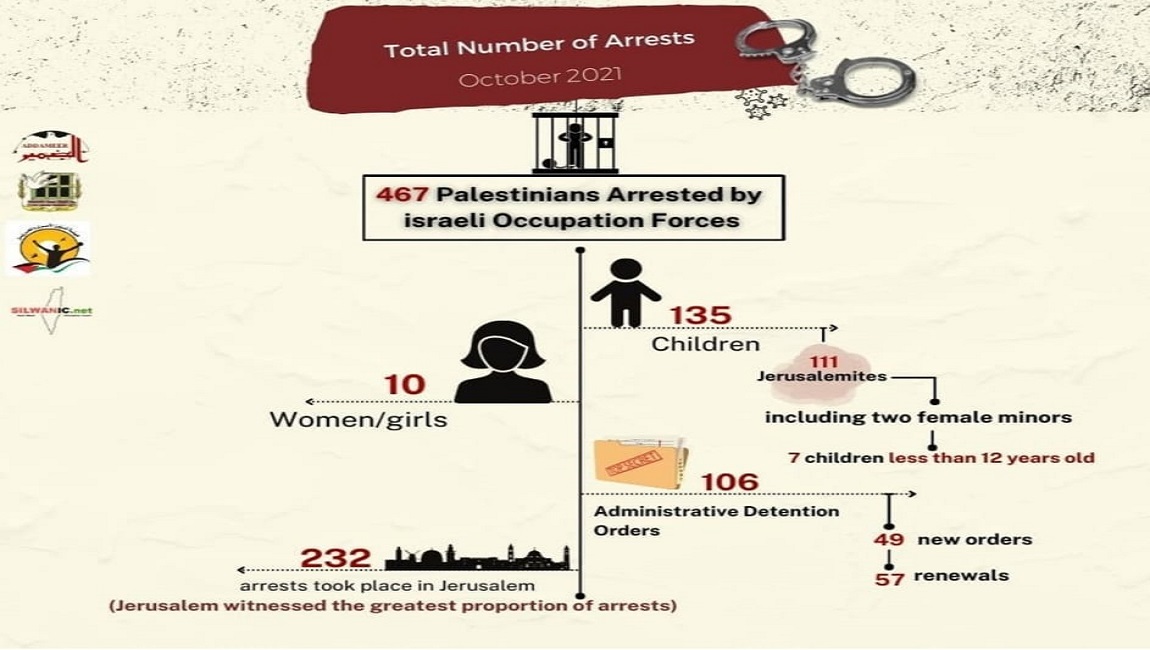
The Israeli Authorities arrested (467) Palestinians on October 2021
The Israeli Authorities arrested (467) Palestinians on October 2021
Ramallah: The Israeli authorities arrested (467) Palestinians on October 2021 including (135) minors and (10) women.
Detainees' institutions and human rights organizations (the Commission of Detainees and Ex-detainees' Affairs, the Palestinian Society Prisoner's Club, Al Dameer Association for Human Rights and Wadi Hilweh Information Center) issued a report and pointed out that the number of Palestinian detainees in Israeli prisons is nearly (4650) detainees, including (34) women, (160) children and (500) administrative detainees.
The report shows all policies and procedures that were carried out by the Israeli authorities against Palestinian detainees, in addition to situation and conditions of detainees in Israeli prisons, and the fierce attacks against the institutions of civil society by labeling them as terrorist organizations.
The occupation's policies and measures
The report reviews part of the occupation's policies and violations that accompany the daily arrests in terms of the condition of detention and the violations related to courts guarantees, which breaches the rights of detained guaranteed by the international humanitarian law.
The policy of administrative detention
(106) administrative detention orders have been issued on October 2021, including (49) new orders and (57) renewals, where the Israeli authorities resort to this policy as a method to reveal the charge of detainee, aiming at undermining the detainees' demands and protests related to the fateful rights of the Palestinian people.
In 2015, the Israeli Supreme Court legitimized the order of "freezing" the sentence of administrative detention against detainees on hunger strike. However, specialized organizations considered this decision as a tool to reinforce the policy of administrative detention. This decision does not cancel the administrative detention order. Rather, it represents abdicating the responsibility of the prisons' administration and the Israeli Intelligence on the fate of the detainee, and turning him into an unofficial “detainee” in the hospital, and he remains under the guardianship of the “security” of the hospital instead of the jailors.
A change took place in dealing with this order during October, through what happened when the prosecution refused to freeze the administrative detention of the detainee Alaa A'raj despite of his critical health condition. This refusal is based on the medical report issued by the Israeli hospital, which did not confirm the possibility of death.
Another case in point is the case of Kayed Fasfous and Miqdad Qawasmeh whose hunger strike exceeded 110 days. This change appeared obviously after activating the administrative detention against Fasfous and Qawasmeh after freezing it.
To the date of publication of this report, six detainees are continuing their hunger strike in a protest against their administrative detention, and all of them are facing critical health conditions. These detainees are; Kayed Fasfous, Miqdad Qawasmeh, Alaa A'raj, Hisham Abu Hawash, Ayyad Hraimi and Luai Ashqar.
Torture and collective punishment during arrests
The occupation authorities use the policy of daily arrests to confront the struggle of Palestinians and to deprive them of their rights and freedom. The range of daily arrests is about (15) cases, accompanied by storming houses and attacks against the detainee and his family.
This is represented in what happened during storming a sit-in in Jerusalem near Alyousifya cemetery, when the occupation forces chased the young men and prevented them from setting in the place. They arrested many young men and released them in few days, but some of them have been charged of throwing stones and obstruct police work.
The majority of detainees were subjected to beat and torture during the process of arrest, such as the 21-year-old detainee Mu'tasem Rajabi, who was going to the supermarket and got arrested there.
Rajabi said that he has been beaten on his face and mouth and lost his consciousness, and then he had a bleeding from his mouth and got his teeth broken. He added "the forces gone after beating me and then we got surprised when the forces came back and arrested me without any reason, and transferred me Qishle police center. I was held from 10:00 pm – 2:00 am, and they refused to give me first aid". The police released him under the condition of house arrest for three days.
Besides, other cities in Palestine are subjected to night storming, especially at the city of Jenin, where the six detainees who freed themselves belong to.
Arrests based on using social media
Arresting Palestinians on the basis of social media posts represents a punitive measure to detain the largest possible number of children, women and youths. A case in point is the 17-year-old Omar Hashlamon from Jerusalem, who has been arrested on the basis of posting on Facebook "I am not sure of being so long in the world, but I hope I've made good memories that last forever". He got summoned after minutes for interrogation, and he got astonished to be interrogated under the suspicion of "planning for terrorist acts". He got prosecuted in the next day and then released.
Detainees' conditions in Israeli prisons
The systematic medical ignorance
The occupation’s systematic method of depriving the detainees of real medical care and the deliberate delay in providing treatment to the sick and injured detainees are among the most important ways and methods of weakening the will and the bodies of detainees.
By monitoring the health status of detainees, it becomes obviuos that the level of health care for them is very poor. Thus, dozens of detainees have been martyred since the beginning of the Israeli occupation of Palestine, and the number of patients has increased.
A case in point is the 94-year-old detainee Naser Abu Hmaid from Ramallah. He suffered from deterioration in his health, particularly from chest and lung pain, and after a long delay, he was subsequently transferred from Ashkelon Prison to Barzulai Hospital in Israel.
It is worthy to mention that the detainee Naser is imprisoned since 2002 and sentenced to life imprisonment and 50 years. He also has four brothers who are sentenced to life imprisonment. Their house got demolished many times and their mother is prevented from visiting them for many years.
Hunger strike to refuse the measures of jailors
The detainees' confrontation of the punitive measures continues since the "freedom tunnel" act, where the strike of the Islamic Jihad detainees, which lasted for 9 days and included (250), constituted an important phase in the confrontation.
Detainees reached an agreement in 21/10/2021 with the administration of prison to fulfill a number of their demands, such as: stopping the fierce attack against detainees, including the Islamic Jihad detainees, canceling the collective punishments imposed on them since the heroic Operation “Freedom Tunnel”, and returning all the isolated detainees, including the leaders of the organizations to the main sections.
Targeting the Palestinian organizations by the occupation authorities
In continuation of undermining the detainees' organizations and Palestinian human rights organizations, the occupation authorities targeted six of Palestinian civil society organizations, labeling them as terrorist organizations. The six organizations are "Addameer Association, the Union of the agricultural work committees, the International Movement of defending the child, Union of Arab Women's Committees and Bisan Research Center", which are leading institutions in defending the rights of Palestinians against the violations of the occupation and exposing its crimes against detainees and children.
It is obvious that this matter will expose thousands of Palestinians, including detainees, to further violations after the occupation deducts their allocations from the clearance funds, and especially that two of these institutions are directly concerned with detainees and children affairs in the occupation prisons.
Despite the efforts of these organizations on the international level to refute this decision, it is a subject of closure and prosecution. The danger of this targeting is not limited to the six organizations only, but it is a step for the occupation to pave the way to target the rest of the Palestinian organizations, especially those concerned with the affairs of political detainees. There is no doubt that these organizations are in dire need for popular support and solidarity, in addition to international support, where the success of the occupation in destroying these organization means that Israel is able to silent the voice of the Palestinian civil society.
In conclusion, the partner organizations confirm that the occupation's practices against the Palestinian people violate the International Humanitarian Law, which bans the acts of collective punishments and revengeful acts against people under occupation.
As article (33) of the Fourth Geneva Convention which applies to the occupied Palestinian territory, gives the Palestinian people, as a people living under occupation, the status of protected persons under the international law, and confirms the Palestinian detainees' rights to be recognized as freedom fighters, in addition to their rights to health care, food and education, and the right to enjoy fair trial guarantees, the right to family visits and respecting their dignity.